“Books, you know, Charles, are like lobster-shells. We surround ourselves with ‘em, and then we grow out of ‘em and leave ‘em behind, as evidence of our earlier stages of development.” – Dorothy Sayers, The Unpleasantness at the Bellona Club, Penguin Books, 1935
This week, 90 years ago in 1935, an imaginative English managing editor launched a small, affordable and striking publishing concept that stands as a cultural landmark over the decades.
Allen Lane (1902-1970) at the time was working with the eminent publishing flagship, The Bodley Head, which his family had founded and which, while revered, was struggling financially with many of the social and cultural changes that were challenging the publishing world at the time.
In 1934, Lane was waiting for a train at the Exeter St Davids railway station and found himself dismayed by the trashy paperbacks on sale in the book racks. Not only were they scrappy looking – their content gave rise to the phrase “pulp fiction”. The Industrial Revolution had contributed to the widespread production of newsprint and the churning out of popular literature that began with “penny dreadfuls” – lowbrow and sensationalist books for the masses.
It occurred to Lane that there could be a market for affordable, portable, well-edited editions that featured the best writers of the time and that would be instantly recognisable all over the world.
Lane’s insight was realised with his brothers, some new talent and some of his Bodley Head colleagues so that each copy could be bought for a mere sixpence under the banner and design of Penguin Books.
In addition to a brilliant business insight, Lane also had an intuitive faith in the literacy of the British public, saying: “We believed in this country in the existence of a vast reading public for intelligent books at a low price, and risked everything on it.”
One of the stars in the Penguin firmament is perhaps one of the most recognisable logos that does not come from the United States: the appealing penguin logo.
The penguin idea came from Lane’s secretary Joan Coles and was realised by a talented 21-year-old naval officer and graphic artist Edward Young, who promptly went to the London Zoo to study and sketch these comical little birds.
Lane was very clear that his concept needed to have a strong visual appeal and power of recognition, while keeping the production costs low. The Penguin company – using this collaboration between Lane and Young – used a simple horizontal design and a striking but simple colour coding for different literature genres, and standardised size.
The colour key quickly became a feature for the way people shelved their Penguins: orange and white for fiction, dark blue and white for biographies, cerise and white for travel books, and so on. This design was used on the Penguin “classics”.
In 1935, Penguin Books published its first ten novels and they included titles by Dorothy Sayers, Agatha Christie, Ernest Hemingway, André Maurois and Compton Mackenzie, among others. The styles were a snapshot of some of the classics of the time, but many have endured as lasting best-sellers.
A year later Penguin Books had sold over a million copies, and this changed the world of publishing. Penguin for instance made the books available at chain stores such as Woolworths. In the years after 1935, Penguin expanded its range by publishing other bird-related series: Puffin Books for children and Pelican Books for non-fiction, using the same design and production principles.
In notable ways the experiences of the 1930s in the Western world resemble our own times: the sense that social institutions have failed; that there are populations of disconnected people, economic uncertainty and swirling pools of populist and counter-cultural movements; the sense of missing or damaged young men and the challenge of ideological mindsets.
At the same time, the 1930s saw an inbreaking of shards of inspiration from Christian writers and creators who challenged the imminent moral and social train crash to which the world was heading. This similarity is in both respects: the civilisational decline and the surprising small sparks of resurgence.
Penguin Books was never a Christian publishing house, but they enabled millions of people to read wonderful books, including some of the great Christian writers. They brought civilisation to the land girls, the bomb shelters and the frontlines of the Second World War.
Today, with the advent of easy fakes, device addiction and AI, there is something valuable about the handy, absorbing and democratic vision of Allen Lane. We now appreciate the quality of being “unwired” and the value of a book that is both worth reading and not so expensive, that it can’t be tucked into a beach towel or left around the kids.
Chances are that some of our readers will still have a special if battered Penguin tucked away on a bookshelf or under a pillow, and which despite Dorothy Sayers’ quote above has not been cast off like a “lobster-shell”.
My first two completely read, small-print books from my time convalescing at the age of eight from a collapsed lung and pneumonia were Puffin books: Arthur Ransome’s boating adventure of the Swallows and Amazons, Swallowdale, and C.S. Lewis’ The Lion, the Witch and the Wardrobe.
We at the Thomas More Centre in a sense share the hope that our excellent content is as attractive, portable, accessible and valuable.
Thank you, Mr Lane, for your gift of foldable, tuckable and wonderful reading!
Some more hopeful news:
Professor Tracey Rowland’s latest book tops Amazon Catholic sales in Australia
Our very engaged TMC patron and prodigious author, Professor Tracey Rowland, informs us that her latest book, Remembering George Cardinal Pell: Recollections of a Great Man of the Church, is thus sitting on the top of the Amazon sales for Australian Catholic publications.
The book’s publisher Ignatius Press’ website describes the unique features of Professor Rowland’s book:
“This book is a record of memories of those who knew Cardinal Pell as a gift to future generations of Catholics who may find this era of history of interest … it is a record for younger Catholics who come from families where their parents and grandparents supported the Cardinal. Since the Cardinal was well known, not only in Australia, but across the entire Anglosphere, this collection of memoirs should be of broad, international interest.”
Contributors include: Cardinal Gerhard Müller, George Weigel, Joanna Bogle, Andrew Bolt, Tony Abbott, Bishop Peter Elliott, Cardinal Timothy Dolan, Sister Mary Grace, S.V., Fr Alexander Sherbrooke, Fr Jerome Santamaria, and many more.
More news about the launch of this book with the TMC in the weeks ahead.
Congratulations to Professor Rowland and all the contributors.
Brisbane TMC Talk – Dave Nightingale on using technology the Catholic way
TMC organiser Mark Makowiecki reports that on the evening of July 29, the Thomas More Centre Brisbane hosted this talk at which Dave spoke about the challenges of using technology wisely in an age in which technological development has outpaced – and largely become unshackled from – traditional moral constraints.
Drawing on Mark 12:30-31 and from the Compendium of the Social Doctrine of the Church, Dave listed several criteria we should use to judge whether our use of technology upholds the dignity of God, ourselves, and our neighbour. Afterwards, a number of attendees headed downstairs for dinner to continue the timely conversation.
Anna Krohn
Executive Director
Thomas More Centre
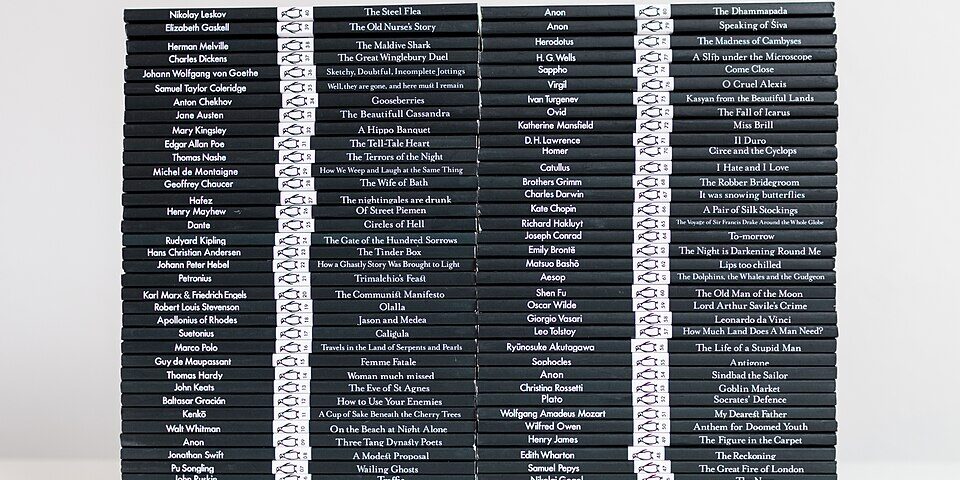
Featured image of Penguin Little Black Classics – a series of 80 classics, sold for 80p celebrating the 80th Birthday of Penguin Classics, from Wikimedia Commons. Credit: Stefan Schäfer. Licensed under the Creative Commons Attribution-Share Alike 4.0 International license.