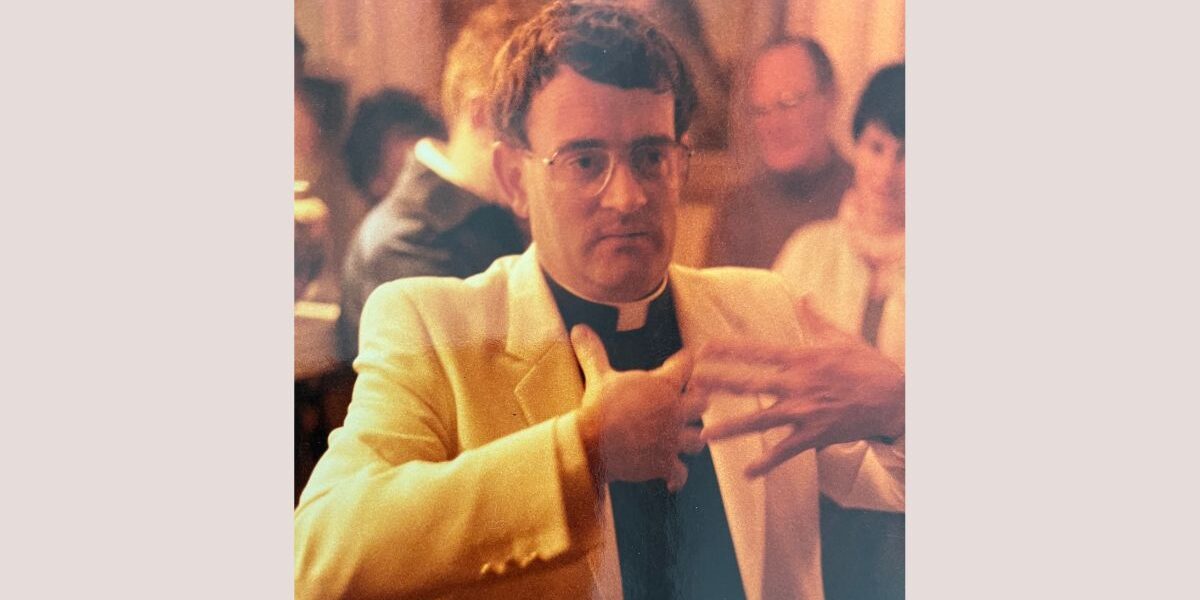
It is with great sense of sad gratitude that many, especially those around the Thomas More Centre, received word that with a mysterious liturgical fittingness the retired Bishop Peter John Elliott died yesterday, August 6, on the Feast of the Transfiguration. He was 81 years old.
The Transfiguration is the feast which celebrates the Christological mystery, captured in the synoptic Gospel accounts of Jesus Christ revealing His glory to the Apostles on Mount Tabor before His journey to the Cross (Matthew 17:1-13; Mark 9:2-9; Luke 9:28-36).
It remains one of the earliest and most potent liturgical feasts being marked by the Churches of the East and the West, along with the Syriac and Coptic Churches.
The Transfiguration also was the day on which Pope St Paul VI died in 1978. It was also on this day that in 1993, Pope St John Paul II issued one of his greatest encyclicals, his defence of the unity between the faculties of faith and reason: Veritatis Splendor.
The unity of the Church around Christ the Redeemer, the valiant efforts of Pope Paul VI to defend the Christian anthropological bases of human love and sexuality, and the vigorous intellectual foundations of Christian faith, all represented different compass points in Bishop Elliott’s extensive ecclesial vocation and in the important contributions he made to these areas and beyond.
They were the bases of the friendships he forged so unobtrusively with young and old, with those in high places and to those suffering all sorts of ills: mental, social and circumstantial. An entire essay could be written on his pastoral kindness.
Although he officially retired in 2018, he remained intellectually attuned until the very last weeks, penning his memoirs and sharing conversations and jokes about the many matters which had drawn his lively intellect and care.
He had recently and peacefully moved to a home for retired priests, Justin Villa, having surprised us all and himself with his toughness in surviving some potentially lethal brushes with ill health in 2020.
In that year, he published a masterful work that was a final in a very important series of books on marriage, which included What God has Joined (1990) and his chapter in God and Eros: The Ethos of the Nuptial Mystery (2015), while he was senior lecturer and final director of the John Paul II Institute for Marriage and Family in Melbourne.
In these books he combined his keen historical sense, his moral and doctrinal insights and his reading of the pulses of culture.
In The Sexual Revolution: History, Ideology, Power (Ignatius, 2023), he stated frankly of the social decay represented by unhinging the notion of creation and moral integrity from the body: “In practical terms it can be summed up in two words: the Pill and abortion. But these major causes came out of the ideas and projects of the key thinkers and activists who shaped this revolution.” A review can be found here.
This year, he contributed a chapter to Professor Tracey Rowland’s most recent book, Remembering George Cardinal Pell: Recollections of a Great Man of the Church (Ignatius, 2025), in which he reveals his long and complementary friendship and collaboration with the cardinal.
Although much more diminutive in physical size than the cardinal, and more soft-spoken, Bishop Elliott was a giant churchman who wore many hats with profound erudition, articulation and with a deeply pastoral heart. He also had a magnetic and dangerous wit and sense of fun!
Professor Rowland told me that she first met the bishop when he was speaking in Queensland in the early 1980s of John Paul II’s restoration of sound catechesis, and he said that “the warm fuzzies are feeling the cold chill of Polish winds”. She said this “made me a fan as I lived through the warm fuzzy approach to R.E.”.
Many other friends have revealed the important role that Bishop Elliott had in their growing up and in their faith. He not only served as a vocational mentor; he also instilled in his many charges a liturgical sensitivity and historical awareness. This extended to surprising places around the world.
Last night the heroic retired Bishop of Hong Kong, Cardinal Joseph Zen, wrote: “We offer our heartfelt prayers for the repose of H.E. Bishop Elliott’s soul. He once visited Hong Kong to share his rich insights on the Sacred Liturgy for which we remain deeply grateful.”
The Archbishop of Melbourne, Peter Comensoli, paid tribute to Bishop Elliott’s unwavering love of Jesus Christ and his very well rounded contributions to the Church: “He brought to the Archdiocese a rare combination of intellectual depth, liturgical beauty, and pastoral warmth. His life was marked by a profound sense of the sacred and a tireless commitment to the Gospel.”
It is impossible in this small space to paint an accurate portrait of Bishop Elliott’s influence on many generations of Catholics and other Christians.
An astute and characterful painting capturing both the whimsy and engagement of the bishop was created by the portrait artist Yi Wang of the bishop and his beloved cat Lady Jacqueline, which became a popular finalist in the 2010 Archibald Prize competition.
In so many ways Bishop Elliott quietly built the foundations for a greater depth and understanding of the Catholic teaching and living of both marriage and priestly vocations, a very practical application of both liturgical practice and awareness, and he played a key role in the first stirrings of a sound catechetical revival in the Church.
He published a number of best-selling books which conveyed his insights in very clear, systematic and appealing ways – parish prayers of the faithful, how to be an altar server, how to pray before the Blessed Sacrament in addition to many other enduring titles along with a number of scholarly works.
When he was an energetic newly converted Catholic priest, Fr Elliott devised an ingenious portable handbook with a fierce yellow cover summarising Catholic faith, life, prayer and morality. He called it the “Little Yellow Book”. He recognised that Maoist cadres and fellow travellers carried the indoctrinating Quotations from Chairman Mao Tse-tung, otherwise known as the Little Red Book, which preached “continuous revolution” and the purification of the class struggle. In contrast the Little Yellow Book would supply the tools for Christian conversion and engagement.
Several years later following a request from young friends, Fr Elliott agreed to present a series called the “Catholic Survival Kit” program which met each Sunday night at the National Civic Council building in Melbourne.
Not only did Fr Elliott convey the excitement of Catholic orthodoxy, his quirky humour and his attention to the questioning of young people bereft of intellectually sustaining religious education attracted growing numbers to the series, which concluded each evening with the growth of lasting friendships.
After his role at the Pontifical Council for the Family in Rome, he kept up a steady communication and hospitality to Dr Joe Santamaria and his friends and where he would continue to offer courses, talks, advice and articles which starred at the Thomas More Centre summer programs in the early 1990s and beyond.
A year and a half ago, a frail but keenly alert Bishop Elliott became excited at the prospect of reviving the Thomas More Centre for the 21st century. He insisted that he be a TMC patron.
In no small part, it was his forays in Catholic formation from the 1980s in Melbourne and elsewhere which became precursors not only for the foundation of the first iteration of the Thomas More Centre that began in 1989, but many other initiatives in Australia and beyond.
Despite his recent death, the TMC does not propose to let Bishop Elliott off the hook as a patron, along with his great friend Cardinal Pell. As Cardinal Zen wrote last night: “We now ask him to continue interceding for the Church, and especially for the Church in Hong Kong.”
Furthermore, as the bishop himself wrote in Remembering George Cardinal Pell: “Heaven is not inhuman. Friendships continue in eternity: after all, Our Lord said, ‘I no longer call you servants, but friends.’”
Requiescat in aeterna pace.
Anna Krohn
Executive Director
Thomas More Centre