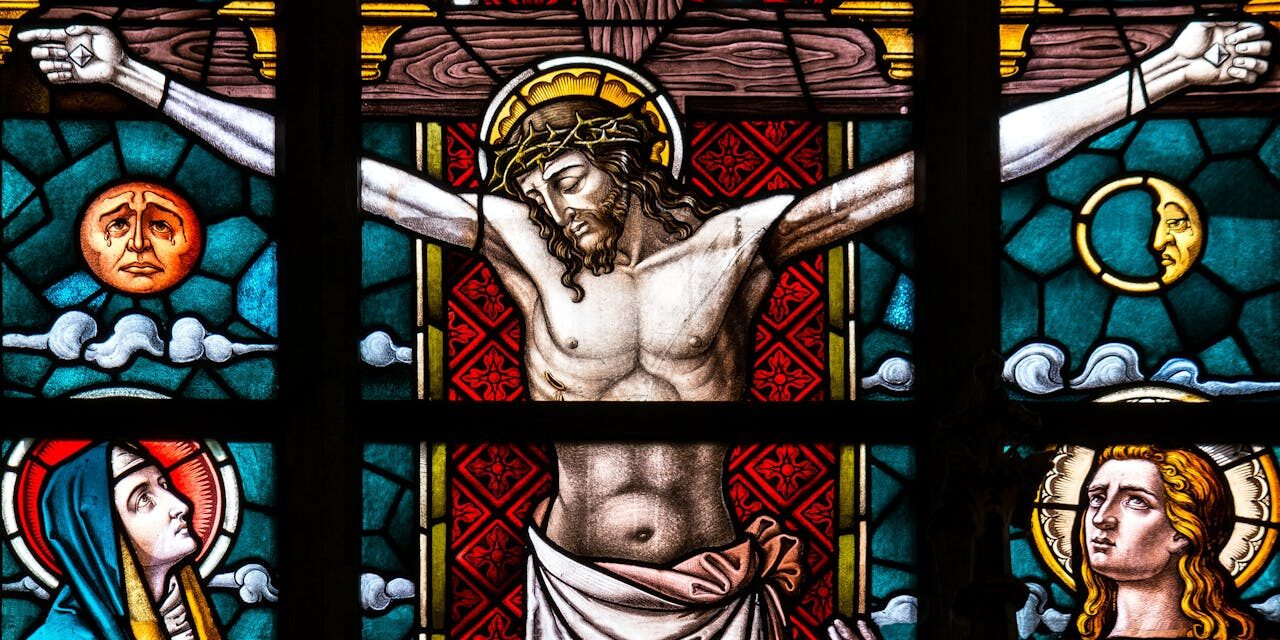
In the liturgical calendar of the Catholic Church before the changes of the 1969 reform, the Church intensified the experience of Lent by calling the weeks from the 5th Sunday of Lent Passiontide.
In a fascinating piece, the 19th-century Benedictine re-founder and liturgical scholar Prosper Louis Pascal Guéranger(1805-1875) explains how the Latin two-week intensified liturgical “sub-season” developed and how it was kept in Catholic countries for many centuries.
In communities today which celebrate the “older” Latin rites, this is still observed. In the Novus Ordo the week of Palm Sunday begins Holy Week, while in the Byzantine liturgical calendar there are 40 days of Lent and Holy or Great Week.
Whichever calendar we observe, there is for many thoughtful Christians the desire to enter more deeply into the central Mysteries of the saving Passion of Christ.
I have deliberately capitalised those terms. The French Oratorian theologian Louis Bouyer (1913-2004) reiterated throughout his theological writing that the Christian “Mystery” is not mystery such as in a detective story, but it was the concrete and transformative drama of God’s saving action incarnated in history, revelation, liturgy, sacrament and in the Church throughout time.
No wonder that, throughout time, Christians and artists have attempted to capture in different and extra-liturgical ways the central drama of cosmic history.
There is a long tradition from mystery plays of the Middle Ages, to the re-enactments of the Stations of the Cross. Since the invention of film technology there have some outstanding dramatisations of the Passion: from the Italian Franco Zeffirelli’s (1923-2019) epic television miniseries Jesus of Nazareth (1977), Mel Gibson’s alternately raw and dream-like The Passion of the Christ (2004) enacted entirely in ancient tongues, to recent episodes of the crowd-funded phenomena The Chosen (2017-present).
Each of these achievements has brought Christ’s Passion not only to life but into lives. Despite affront and opposition from many in the secular film industry, these works have touched and transformed the lives of untold millions, not least of all lives of many of the actors, directors and crew.
It is notable that many decades before these influential productions, Dorothy L. Sayers (1893–1957), the brilliant English High-Anglican poet, translator, advertising copywriter and novelist, brought to wartime BBC Radio an ambitious, and at the time controversial, 12-part radio dramatisation called Jesus: The Man Born to Be King (1944).
Interestingly, Sayers was a masterly creative writer of mysteries in two senses: she was a mystery writer and a theologian of the Christian Mystery. She was one of the four “Queens of Crime” – the elite female crime writers of the “golden age of detection” along with Agatha Christie, Ngaio Marsh and Margery Allingham.
She was also deeply theologically engaged, an associate of The Inklings and an admirer of G. K. Chesterton. The English Dominican theologian, Fr Aidan Nichols, included Sayers in his book on spiritual guides for the 21st century and called her “the bright star of the Anglo-Catholic tradition”.
Sayers’ play-cycle is remarkable for its use of vernacular dialogue, gripping character studies (with fascinating character notes from the playwright included before each play), historically researched production notes and her making concrete the complex and flawed personalities surrounding Jesus Christ during his mission on Earth.
The apostle and reformed tax collector Matthew speaks in a type of East-end cockney. Like Zeffirelli years later, Sayers tackles the character of Judas with imaginative attention. She writes in her character notes: “Judas in the Gospels is an enigma … he is a strange mixture of the sensitive and the insensitive.”
Sayers understood the “theo-dramatic” (as later theologians would describe it), the idea that, as she writes, “the drama is the dogma”. By this she wanted to arouse an authentic and engaged Christian consciousness, to snap listeners out of an abstract, fragmented and depersonalised Christianity.
She believed that realism, intelligence and craft were necessary in the production of Christian drama, arguing that “a loose and sentimental theology begets loose and sentimental art forms … an illogical theology lands one in illogical situations.”
Her cycle of plays was broadcast in 1941-42 with the actor Robert Speight playing the part of Jesus Christ and with the support of the BBC’s Head of Productions (Val Gielgud, brother of actor Sir John Gielgud). It was instantly popular and controversial.
C.S. Lewis treated her work as spiritual reading, meditating on it each Lent. He wrote: “D. Sayers’ [sic] Man Born to be King has edified us in this country more than anything for a long time.”
Perhaps it is Sayers’ reflections on a world in unstable and warlike times that makes it so apt for our Passiontide this year.
She wrote in the production notes: “(Jesus) was executed by a corrupt Church, a timid politician and a fickle proletariat led by professional agitators.” She saw the dangerous rise of murderous ideologies not fixed to her own time, but to all sinful humanity – a humanity always needing the Saviour.
Probing the consciences of us all she wrote: “God was executed by people painfully like us.”
TMC Events – Melbourne
1. Cordial invitation to TMC supporters: Book launch, April 10, Melbourne
Melbourne architect Stephen Clements has extended to all TMC readers an invitation to attend the launch of his book, A Prize in My Heart – Cyril Kelly, about the Australian Church and institutional designer who worked on the Corpus Christi Seminary in Glen Waverley and on St Patrick’s College Chapel, Ballarat.
Clements argues: “Though often overlooked beside more celebrated contemporaries, Kelly emerges here as a figure of prodigious energy, firm conviction and enduring faith.”
Stephen’s book will be launched by the popular educator David Schütz at Catholic Theological College (278 Victoria Parade, East Melbourne) at 6pm, Friday, April 10, 2026. For more information, please contact jo*************@***il.com.
2. TMC book launch, April 23, 6.30-8pm
All newsletter subscribers are welcome to attend the forthcoming book launch of Introducing Communio Theology, in which Professor Tracey Rowland offers an accessible yet profound exploration of this influential theological movement in the Church.
The book examines a number of theological and cultural questions, including the understanding of Tradition, scriptural inspiration and exegesis, moral theology in the modern world, feminism, the nature of priesthood, contemporary ecological concerns, and the causes of secularism within the cultures of modernity and postmodernity.
When: Thursday, April 23, 2026 at 6.30pm
Where: St Peter’s Parish, Toorak, 581 Toorak Road
Ticket cost: $15
Refreshments will be served. Please book here to assist with the catering.
Wishing for peace and grace during this Holy Saturday and a blessed Easter!
Anna Krohn
Executive Director
Thomas More Centre