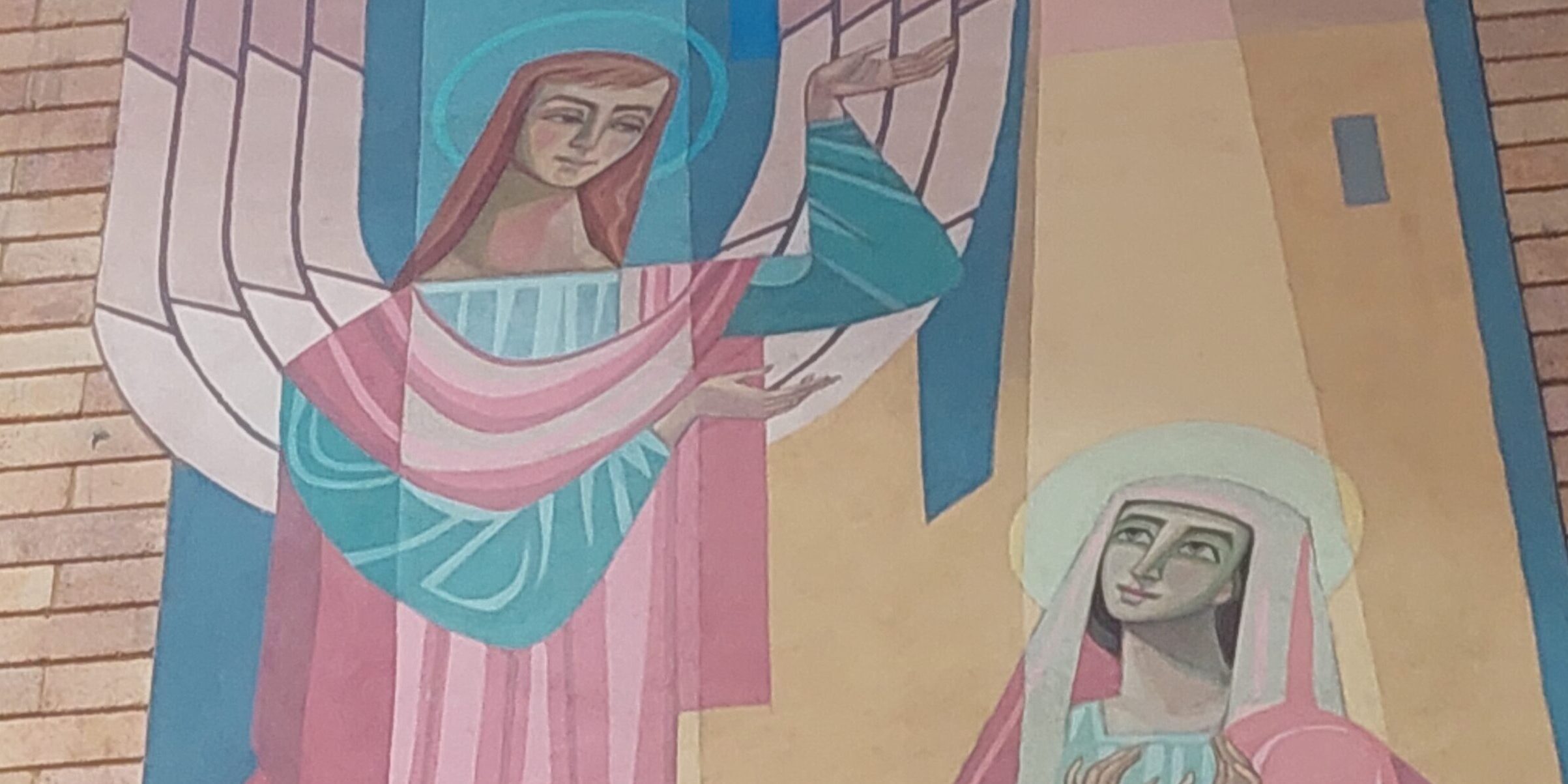
Yesterday was the Feast of the Annunciation in the Latin and Byzantine (Gregorian) Church calendars. It marks for all Christians a cosmic, liturgical and historical pivot point. It celebrates the crucial dramatic moment between God’s Old and New Covenants with humanity.
Read with fresh eyes, the biblical verses are still astounding. They record the moments in which a young thoughtful and faithful Jewish woman of Galilee, Mary, utters a free and undiluted reply, which acts like a key in the sin-locked door of human history: “Let it be” (Latin = fiat / Greek = γένοιτό, genoito, “may it happen”) to the enormous and prophetic words of her angel visitor. (Luke 1:26-28)
In a profound address to the Church’s new cardinals on this Feast Day 20 years ago, Pope Benedict XVI called the Annunciation the Church and the world’s “primordial wellspring” for at “that moment the eternal Word began to exist as a human being in time”.
Pope Benedict reveals in his same address that Mary is called by the Angel a scripturally unique name: “full of grace”. In Greek, this is κεχαριτωμένη (Kecharitome), an unusual construction – a perfect passive participle capturing a sense of achievement and ongoing divine favour.
Mary, a human creature who is blessed and stunningly empowered with the fullness of God’s love is actively receptive. Pope Benedict said:
“Mary is fully active, because she accepts with personal generosity the wave of God’s love poured out upon her. In this too, she is the perfect disciple of her Son, who realises the fullness of his freedom and thus exercises the freedom through obedience to the Father.”
In the sacramental Christian tradition, this also conveys the sense of Mary in maternal solidarity with all Christians and all humanity, especially in times of persecution, hardship and war.
One Catholic writer who captured this sense of Christian solidarity in a Marian register was the “eccentric” English Catholic revert Caryll Houselander (1901-1954).
Caryll, named after her socialite father’s yacht, was a remarkable person. She was an artist, poet, first-aid worker and for a time a self-taught child therapist. In the 1940s and 50s her spiritual writings were best-sellers, and they have recently been reprinted for newer generations. Caryll’s down-to-earth and emotionally honest writings consoled and accompanied many people through the deprivations and traumas of the Second World War and its aftermath.
Caryll was beset by ill health and emotional suffering for most of her life. Her autobiography titled The Rocking Horse Catholic was published just after her death by Sheed and Ward in 1955 (reprinted recently here).
She was not conventional in either her appearance or attitude to life. She sported dyed red bobbed hair, eyes goggled by heavy spectacles and hands stained by her smoking incessantly. She died in the grey shadows and deprivation of post-war England of breast cancer.
From a young age, Caryll had begun to have vivid and Christological visions, and mystical images that gave her insights into the quality of Christological discipleship and of the growth (or neglect) of what she called “the Christ-life” in the souls of Christians.
These visions occurred in remarkably mundane and unexpected places – on the London Underground or on the shoe-polishing benches of her school.
Yet her theological insights still convey a fresh appreciation of the Annunciation and what it offers to us today.
Like Pope Benedict decades later, Caryll in her most popular book The Reed of God (Sheed and Ward, 1944) called the Annunciation “the Wedding of the Holy Spirit with humanity”.
Far from being an ethereal Catholic devotion, the Annunciation reminded Caryll of the radical call to Christian humility and compassion. She writes:
“Indeed the Architect of Love has built the door into heaven, so low that no one but a small child can pass through it,” unless that person has the sense of reverence to make themselves small by crawling on his or her knees.
Caryll had some dear friends who seemed to love and accept her, people such as Frank Sheed and his wife Maisie Ward (her publishers) and Monsignor Ronald Knox, but she often suffered misunderstanding.
Puncturing the self-sufficiency of “reality” help social media, Caryll found in St Luke’s verses her inspiration in humility, admitting that even in our ongoing conversion we will still respond to grace in our falls, blindness, and through our limitations “it will have to be the love of humility, that is, love informed by humility – long-suffering, patient, and humorous. If we realise that we are a little absurd, such love will come more easily.”
It is the young Mary who gives to her divine Son and to us “the gift of her humanity” for which “she says “yes” for all of us.
If we consent to share in her “yes”, we can receive God’s grace to allow the “Christ-life” to become incarnated in our lives – despite our fear, self-interest, woundedness and obduracy of heart.
The price of this is also to share in the Virgin Mary’s solidarity with her Son and therefore in the wounds of others in our daily lives. This can be excruciating, as writes Caryll, “We shall have X-ray minds and shall see through the bandages people have laid of the wounds that sin has dealt them.”
When the Virgin Mary consented to bear the Son of God, Caryll writes, she consented to bring Christ into the all the world “not only in secluded lives, protected lives, the lives of holy people, but into the lives of those haunted by worry, by poverty, by debts, by fears and temptations, subject to chance, to accident, to persecution, to the fortunes of war”.
A sobering and radical vision drawing from the unborn Word and his Mother in our own troubled times.
Save the Date – Melbourne Book Launch, April 23
Professor Tracey Rowland with her prodigious output as a theological writer will have a Melbourne book launch with the Thomas More Centre with the support of the Central Catholic Bookshop at St Peter’s Parish, Toorak.
In Introducing Communio Theology, Professor Tracey Rowland offers an accessible yet profound exploration of this influential theological movement in the Church.
Professor Tracey Rowland examines a number of theological and cultural questions, including the understanding of Tradition, scriptural inspiration and exegesis, moral theology in the modern world, feminism, the nature of priesthood, contemporary ecological concerns, and the causes of secularism within the cultures of modernity and postmodernity.
When: Thursday, April 23, 2026 at 6.30pm
Where: St Peter’s Parish, Toorak, 581 Toorak Road
Anna Krohn
Executive Director
Thomas More Centre
Featured image: Annunciation, St Andrew’s Ukrainian Catholic Church, Lidcombe, NSW. Photo credit: Anna Krohn