In the Catholic world, the month of May was specially dedicated to Mary the Mother of Christ. In recent years, or at least since the declaration of Pope Pius XII in 1955, the month of May opens with the Feast of St Joseph the Worker.
St Joseph: Model of Lay Formation
Since that time there has been a growing interest in the example and significance of St Joseph for the development of Catholic Social Teaching and its promotion amongst men and women. Joseph is an important starting point for this endeavour today.
St Joseph is the patron figure for the dignity of work and the worker, he is the protector of the family, the legal father and formator in the human sense of Christ Jesus and an icon of silent courage in the face of God’s vocational call.
The evangelist St Matthew describes Joseph as being a member of the House of King David and a “righteous” man in Hebrew: tsaddiq (Matthew 1:19). The term represents a multidimensional virtue. Righteousness here involves the lifelong formation of personal commitment and social virtue. It involved a responsibility to the family, to neighbours and to the wider community including the “stranger”.
The New Testament describes Joseph using a term in Greek: tekton. This suggests that Joseph was a skilled artisan, a carpenter who passed on both his skills and his ethos to Jesus.
In a very thoughtful article, Stratford Caldecott links the faith, character, and vocation of St Joseph under the nobility of “chivalry”, a quality desperately needed in the recovery of men and masculinity in our times.
May and Social Teaching
A number of “modern” Papal documents on Catholic Social Teaching – which address the ethos of work, the impact of war and technology, virtues of justice and solidarity – have been published in the month of May.
This includes of course Pope Leo XIV’s first encyclical, Magnifica Humanitas (Magnificent Humanity) published on May 25 this year. (More on this to come.)
The May-published social teaching encyclicals in modern times began with the foundational Rerum Novarum (on New/Revolutionary Things) by Pope Leo XIII (May 15, 1891). Other papal encyclicals published in May that celebrate and address Pope Leo XIII’s document are Pius XI’s Quadragesimo Anno (May 15, 1941), John XXIII’s Mater et Magistra (May 15, 1961) and Francis’ Laudatio Si’ (May 24, 2016).
Formation from Centesimus Annus
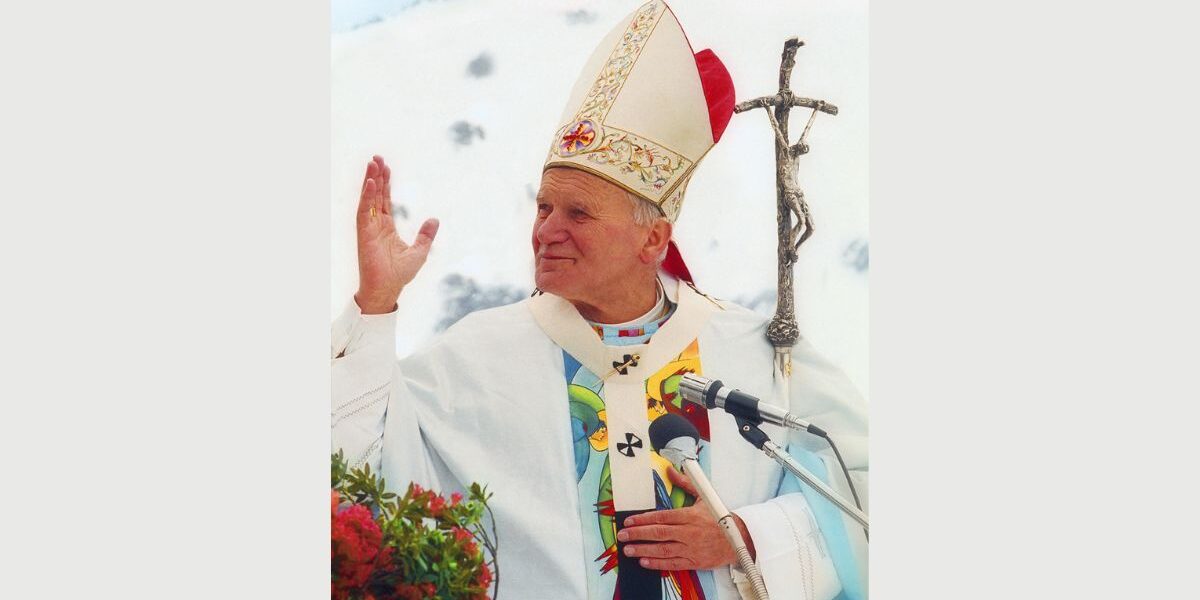
A particularly sophisticated encyclical that begins with an extended study, which ties new insights to Rerum Novarum, is Pope St John Paul II’s ninth encyclical Centesimus Annus (CA), published on the Feast of St Joseph the Worker, 1991.
The Polish Pope’s biographer George Weigel, in his recent articles that celebrate the 35th anniversary of the promulgation of CA, rightly identifies John Paul II’s integration of Catholic social insight and action along the spine of the “mediating” role of culture, ethics and relationships.
Weigel observes that in CA no. 39, John Paul II acknowledges that it is not “economic systems” in themselves that are destructive of humanity, but the moral and spiritual “ethos” of the cultures that thrive or derive from those systems.
An important development in John Paul II’s thought is the importance of creativity, moral freedom and the development of human expression through work and industry.
John Paul II published CA during the crisis of European Marxism and the collapse of the Soviet Union. He writes in CA that Marxism, which he both studied and resisted, cancelled out entirely the basic goods of the human person, the family and any sense of a natural, God-formed or destined creation.
Its totalising systems denied human moral or political freedom and thus imposed a culture of inhumanity, brutality and banality.
The Pope then warns that the disintegration of this form of Marxism did not guarantee that Western society had sufficient answers for societal justice or well-being.
The Pope writes: “It seeks to defeat Marxism on the level of pure materialism by showing how a free-market society can achieve a greater satisfaction of material human needs than Communism, while equally excluding spiritual values.”
Much of Western political discussion and its “mediating structures” have collapsed not only due to hostile “ideologies”, but because of a “culture of death” in which the West has lost its moral, intellectual and cultural centre of gravity.
Centesimus Annus brings together and should be read today in concert with Pope John Paul II’s other insights on the dignity of work, of the form of human bodiliness and sexuality, on the natural family, on the ethos of solidarity and his rich notion of “the culture of life”.
The Pope writes in n. 24 of CA of both the hope and the fragility of the post-Soviet movements, that some of them fed by an awareness of “the spiritual void brought about by atheism, which deprived the younger generations of a sense of direction and in many cases led them, in the irrepressible search for personal identity and for the meaning of life, to rediscover the religious roots of their national cultures, and to rediscover the person of Christ himself as the existentially adequate response to the desire in every human heart for goodness, truth and life”.
These words touching upon the hunger and confusion about identity at both the personal and societal levels seem prophetic in light of the upheavals of 2026.
The Thomas More Centre’s central aim is to provide events and opportunities for building up the common good through formational relationships, resources and experiences.
Much of CA remains an important blueprint and reference for shaping our future work. The formation of people, communities and friendships is essential and integral to social renewal and national renewal.
John Paul II reminds us that such formation must include the understanding and cultivation of personal, professional and institutional virtue and responsibility grounded in the God-given and graced source of human dignity, which promotes uplifting, creative and robust intellectual and cultural study of the truly humane in Christian social wisdom and example.
YPAT 2026
One practical and introductory program we are promoting is YPAT (Young Political Advocacy Training), a multi-day residential training program for young adults aged between 18-30. Participants gain the knowledge and the tools they need to make a difference – exploring politics, culture and society through topics like ethics, practical politics, leadership and governance, economics and history – all while making lifelong friends.
Launched in 2009 by the Thomas More Centre, YPAT has constantly adapted to the next generation and now boasts of over 300 alumni.
When: July 3-8, 2026
Where: The University of Queensland, Brisbane
Cost: $600 (including the program, food and accommodation) or $300 (no accommodation and breakfast)
Applications are due now – don’t miss out and apply here, or please spread the word and encourage young people to apply.
Anna Krohn
Executive Director
Thomas More Centre
Featured image credit: Gregorini Demetrio. Image cropped. CC BY-SA 3.0.