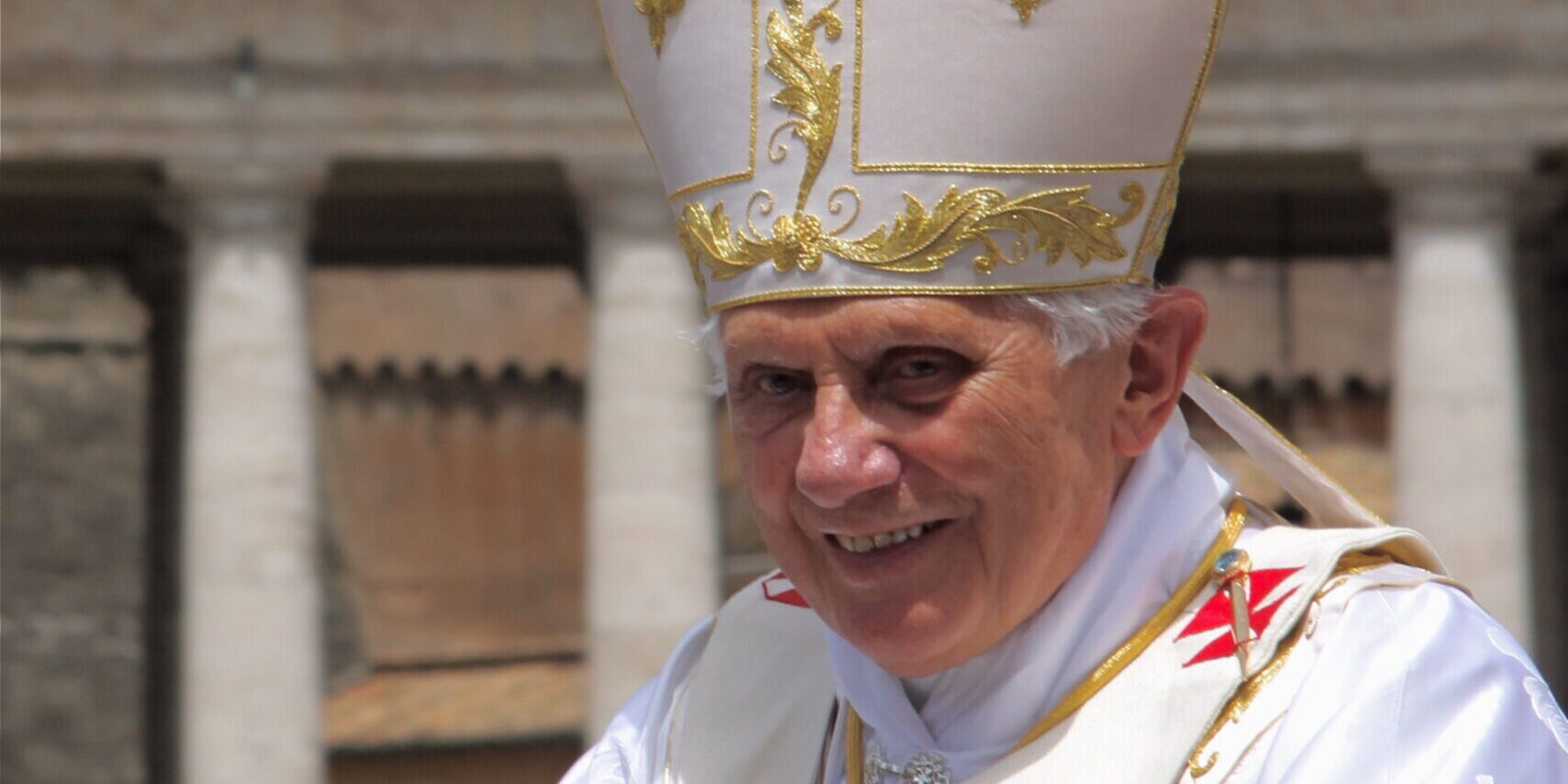
When the great personalities behind the foundation of the Thomas More Centre were working on its vision in 1989, Cardinal Joseph Ratzinger headed the Congregation for the Doctrine of the Faith. Facing many of the theological issues within the Church, he also explained with masterly precision the root cause of many of the cultural challenges of the West.
In that year he gave what would become a deeply prescient precis of these in his address to the bishops in Australia entitled, “Difficulties Confronting the Faith in Europe Today”.
The future pontiff wanted the assembled apostles to recognise that the acknowledged difficulties to Christian faith was not a matter of one or other moral dissent or one particular liturgical practice or abuse, as important and symptomatic these might be; rather, he saw the crisis stemming from a wholesale paradigm shift that involved the rejection of the Christian vision of the human person and of God’s creation. He saw it as a crisis of theological anthropology.
Cardinal Ratzinger argued that dissent on matters of conscience, catechism, contraception, communion liturgy and doctrine were linked:
“They spring from one and the same vision of humanity within which there operates a particular notion of human freedom.”
The crisis was not in his view simply traceable to the Second Vatican Council, but extended back through history leading individuals and communities to reject or drift away from the Church because of a fundamentally anti-sacramental worldview and existential “re-orientation”.
The secularised and truncated view of human freedom, Ratzinger said, infects fundamental relationships between men and women, between life and grace and even between our consciousness and our bodies.
He said that for modern persons, “the body then comes to be considered as a possession which a person can make use of in whatever way seems to him most helpful in attaining ‘quality of life’”.
“The body is something that one has and that one uses. No longer does man expect to receive a message from his bodiliness as to who he is and what he should do.”
Here it is clear that Ratzinger and the pontiff at the time, Pope John Paul II, shared a vision to renew the sacramental and bodily view of the human person.
The renewal of the Church and society will only occur, the Cardinal urged, when there is a renewal of an integrated and robust approach to the Christian appreciation of creation, of a sound philosophy and metaphysics of the truth, a deeper enactment of the sacramental reality of the Church and an urgent reminder of the eschaton, our journey towards the transcendent and eternal life.
Cardinal Ratzinger, paraphrasing the great medieval Byzantine lay theologian, St Nicholas Cabasilas (circa 1320-1390), urged his episcopal audience: “Only the exigency of eternal life confers its absolute urgency on the moral duty of this life. If, however, heaven is only something ‘ahead’ of us and no longer ‘above’ us, then the interior tension of human existence and its communal responsibility are slackened.”
Almost shockingly to his audience at the time were his remarks that this displacement of eschatology lead to a loss of meaning and purpose and “an idolisation of Utopia”, which misleads young people into a drug culture or other addictions.
At the time, Dr Joseph Santamaria clicked with this insight as he dedicated his life to assisting those afflicted and marginalised by such addictions to substances, and why he saw formation about the human person as so essential to the work of the Thomas More Centre.
The 19th of April marked 21 years since the election of Cardinal Ratzinger to the throne of St Peter. So much of the address cited above was programmatic for the labours of his papacy and sprang from his vision for Communio, the journal he co-founded, which aims to bring together scholars from different disciplines and languages in order to renew theology and the life of the Church.
Only by studying modern existence in this way, Cardinal Ratzinger said in his address: “Only then can we reveal the faith as the alternative which the world awaits after the failure of the liberalistic and Marxist experiments.”
It is therefore more than fitting that it is during this anniversary week that TMC would gently urge those living in Melbourne to broaden their appreciation of Pope Benedict’s legacy:
Professor Tracey Rowland’s book launch, April 23
Introducing Communio Theology by our eminent and generous Thomas More Centre patron, Professor Tracey Rowland, offers an accessible yet profound exploration of this influential theological movement in the Church.
Professor Rowland is the 2020 recipient of the prestigious Ratzinger Prize because of her theological analysis of culture and her expertise in the thought of Pope Benedict XVI.
She is also a member of the Pontifical Academy of Social Sciences and the John Paul II Research Professor at the University of Notre Dame Australia.
Her book being launched examines a number of theological and cultural questions while making accessible the wide-ranging umbrella of Communio theology, which is grounded in Trinitarian reflection.
As Professor Rowland explains in her preface, Communio theology attempts to restore and repair to an integrated Christian life and thought both nature and grace, Scripture and philosophy, faith and reason, between the mystical life of Eastern and Western Christianity and tradition and the development of doctrine.
The book examines how Communio theology approaches Tradition, scriptural inspiration and exegesis, moral theology in the modern world, feminism, the nature of priesthood, contemporary ecological concerns, and the causes of secularism within the cultures of modernity and postmodernity.
When: Thursday, April 23, 2026 at 6.30pm
Where: St Peter’s Parish, Toorak, 581 Toorak Road
Ticket cost: $15
With the support of the Central Catholic Bookshop, this new book will be available at a discounted price for this event.
Refreshments will be served. Please book here to assist with the catering.
For the Thomas More Centre newsletter archives, please click here.
For further information, please contact anna.krohn@tmc.org.au.
In the light of this anniversary and important cultural analysis, we also recommend:
Dawson Centre talk, April 29
Our friends at the Christopher Dawson Centre for Cultural Studies extend a cordial invitation to all TMC newsletter subscribers and readers to an event on Thursday, April 30, 2026.
Come and hear Dr Christopher Reynolds speak about his new book, What a Capital Idea: Australia 1770-1901. The book is available for purchase on the night.
When: Wednesday, April 29, 2026 | 7pm – 8pm
Where: Manhattan Hotel, Canterbury Road, Ringwood, Victoria
Tickets are free, but places are limited and can be secured at
Eventbrite here.
We look forward to further TMC news and insights from these events in the newsletters to come.
Anna Krohn
Executive Director
Thomas More Centre
Featured image credit: Mark Bray. Image cropped. Taken from Wikimedia Commons. CC BY 2.0.