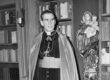
On this Easter Sunday during the Easter Morning Mass in his Cathedral in Trondheim, Norway, the Trappist Bishop Erik Varden declared with his characteristically fresh crispness that we should keep the traditional Eastertide greeting: “Christ is Risen! He is Risen Indeed!” on the tips of our tongues.
He urged his congregation (and his blog readers) that: “We really ought at all times to live, work, and relate to others in this way. The resurrection transforms and illumines existence as such.”
In his homily, Bishop Varden explains how Christ’s Resurrection both fulfils our natural hope for life after death and yet confronts his disciples, both scriptural and now, with its startling weirdness.
We need culturally articulate converts such as Erik Varden to peel the skin of habit and custom from our eyes about Easter – and in this case to douse us with Nordic directness so that we re-see that “Easter changes everything”.
One hundred years prior, Sigrid Undset (1882-1949), the Danish-born Norwegian playwright, writer and novelist, serves as something of a lodestar for the small but reviving Catholic community and culture which Bishop Varden leads in Scandinavia and beyond today.
Undset was, like Bishop Varden, a convert to Catholicism from an indifferent secularised Lutheran upbringing and like him had an acute sense of the cultural, liturgical, historical, and moral weight of Christ and the Church in the world.
In his superb study Sigrid Undset: Reader of Hearts (Ignatius, 2022), the English Dominican theologian, Fr Aidan Nichols, traces the converging paths in the intellectual, moral and spiritual conversion of Undset, beginning with her youthful liberal agnosticism, to her anti-modern social realism, to traditional Catholicism in 1924.
Fr Nichols writes that, even though written between 1921-23, before her final reception into the Church in 1924, Undset’s monumental medieval three-part saga Kristin Lavransdatter may well contend for the title of “greatest Catholic novel of the 20th century”.
Not only did this landmark Catholic work earn Undset the Nobel Prize for literature in 1928; it remains one of the masterpieces of European literature for the century.
This trilogy and next series of four books, Olav Audunssøn or The Master of Hestviken (1925–27) are vivid sagas of the inner life, set within the 13th and 14th centuries. Their narrative arcs burst into the ideologically turbulent and morally drained secular culture of the 1920s with bracing literary force and moral and theological intentionality.
Undset penned at least 30 other masterly books and many other essays, including novels, lives of the saints and anti-totalitarian critique.
Her medieval works were a radically new form of historical fiction – meticulously historically researched, vividly brought to life for a modern era with entirely gripping protagonists who struggle with their own personal sagas of life, raw and dismaying with failure, sinfulness and stubborn self-sufficiency, while still drawn on by a visceral immersion in the beauties and decay of the natural world.
What sets Undset’s writing apart and places her in the ranks of such classics as Evelyn Waugh’s Brideshead Revisited is that Undset brings her characters’ struggles with sin, failure and egoism into the transformative touch of the “Great Christ” and with a sacramental matrix of grace, forgiveness and liturgical prayer.
A number of important influences seem to have led her on this utterly counter-cultural path.
Her father, Ingvald Martin Undset, was a scholarly Danish archaeologist with a fascination with Norway’s medieval culture, and her mother Charlotte had a curious and rich artistic imagination.
Until his death when Sigrid was 11, Ingvald would take her on a type of reverential scholarly pilgrimage to the sites of the old Catholic Cathedral in Nidaros (today, Trondheim).
Sigrid became absorbed by the art of Italy and English language and literature, and after spending time in her beloved city of Rome, returned to work as an office clerk with the German electronics company AEC in Christiania (today, Oslo).
Because her family experienced economic hardship with the death of her father, she would begin her extraordinary literary work at night after her office work.
Publishers encouraged her to write “modern” novels that baulked at traditional moral and social norms. Instead of sounding like Henrik Ibsen or Virginia Woolf, however, Undset found that with her acute eye and experiences, along with her consciousness of history, her knowledge of the natural world, her abhorrence of brutal ideologies, the trials of a fragmenting marriage and a feckless artist husband, led her to be a writer of resistance to the destructive trends of her time. During the Nazi years, she would escape to America for a time with her youngest son Hans to assist with the Norwegian resistance movement.
As both Fr Nichols and the Norwegian Sister Anne Bente Hadland observe, Undset’s conversion begins with a social realism and moves to a metaphysical vision of the purpose and ends of creation and human beings: what might be called since Pope St John Paul II “the culture of life”. This put her at odds with contraception-toting feminists and eugenicists emerging in her time. G.K. Chesterton’s condemnation of the anti-family and anti-life intellectual fashions of the time also attracted her.
In her Catholic years, she was drawn to St Thomas Aquinas to build on her intellectual honesty and acute eye. As Fr Nichols describes: “It is a virkelighedsfilosofi … a philosophy of the real.”
She joined the Dominican Order (as a lay tertiary) and then applied her scholarly research with her imaginative skills explaining Christ’s Paschal Mystery and its transformative power in human lives, culture and history.
Undset took her final step to the Church at a time in Norway when “the old faith” was viewed as alien and backward against the post-Kantian self-sufficiency of her culture. Not only was she to become the most famous Catholic convert in Norway, her house and garden Bjerkebaek near Lillehammer became a tiny hub for Catholic liturgical and cultural celebration. (The house site has been re-opened and restored as a cultural and pilgrimage site.)
Undset synthesised narrative realism with the hope-filled inundation of Easter fire. This for her was not only a revolution but a “penetration” of reality. Her 21st-century spiritual son, Bishop Erik Varden, captures this in an interview in 2023:
“(Easter) … proclaims that what we think of as defining our lives — transience, death, any number of wounds — is not, in fact, final; that there is a balm in Gilead healing us now and effectively obliterating all that seems to sabotage joy. Well, then reality is transformed, wouldn’t you say? We find ourselves stepping into a wholly new dimension of being, if we’ve the guts for it, and the love.”
Tracey Rowland’s book launch, April 23, 6.30-8pm
A gentle reminder that all newsletter subscribers are welcome to attend the forthcoming book launch of Introducing Communio Theology, in which Professor Tracey Rowland offers an accessible yet profound exploration of this influential theological movement in the Church.
The book examines a number of theological and cultural questions, including the understanding of Tradition, scriptural inspiration and exegesis, moral theology in the modern world, feminism, the nature of priesthood, contemporary ecological concerns, and the causes of secularism within the cultures of modernity and postmodernity.
When: Thursday, April 23, 2026 at 6.30pm
Where: St Peter’s Parish, Toorak, 581 Toorak Road
Ticket cost: $15
Refreshments will be served. Please book here to assist with the catering.
He has Risen Indeed!
Anna Krohn
Executive Director
Thomas More Centre
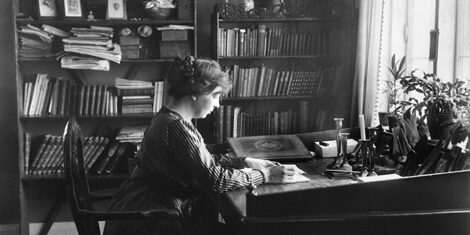
Featured image of Sigrid Undset, Bjerkebæk. Public domain.