In the Northern Hemisphere this week, the birth of the prophet and forerunner St John the Baptist (June 24) is celebrated with both a religious and cosmic sense.
The Forerunner announces the true light of Jesus Christ and the passing on and over of the torch of light from the Old Covenant to the “New”.
St John’s birthday is celebrated in the calendar as a type of “summer Christmas” as it is paired directly with the Nativity of Jesus Christ on December 25. St John’s feast marks midsummer and the summer solstice, just as here in the Southern Hemisphere his feast marks midwinter. The Baptist whose fiery purity was seen as “cleansing fire” for the coming of the Messiah.
In Scandinavia, Mexico, France, Spain, Poland, Ireland and other countries, there are still traces of richly textured customs around St John’s Eve bonfires, where fuel was stacked high for a mighty conflagration around which hearty hospitality is offered. The link here takes you to a revival of the feast in America by the Catholic Rural Movement in the 1940s (of which our own Movement is related).
In Ireland the fire is called Tine Cnámh, a derivation of the word that gives us the English “bonfire” or “bone-fire”, in which the refuse of weeds and animal bones were thrown upon the fire to cleanse and purify the land and the farming community. There are still ritual customs associated with this cleansing while the parish priest blessed the fire with these words:
“In the honour of God and of St John, to the fruitfulness and profit of our planting and our work, in the name of the Father and of the Son and of the Holy Spirit, Amen.”
There were simple rituals such as the leaping over the bonfire, which represented feats of discipline, courage and daring that were also associated with St John the Baptist. The bonfire became the fire that burned away fear, complacency and mediocrity, a “bonfire of vanities” that also inspired the traditions of St John’s Eve on the island of Malta and cemented St John’s patronage of the Sovereign Military Order of Malta or The Knights of Malta.
Last year, Pope Leo XIV reminded the Order of the daunting witness and illumination offered by The Baptist.
The feast was a baptising of earlier pagan solstice celebrations in rural communities, so that the link between the yearly cycle, the personal journey of virtue and the symbols taken from revelation could be brought together.
In the Church’s liturgy, the Canticle of Zechariah, the father of the Baptist underscores his son’s blazing witness: “And thou, child, shalt be called the prophet of the Highest: for thou shalt … enlighten them that sit in darkness, and in the shadow of death.” (Luke 1:76-79)
The Three Bonfires of Conscience
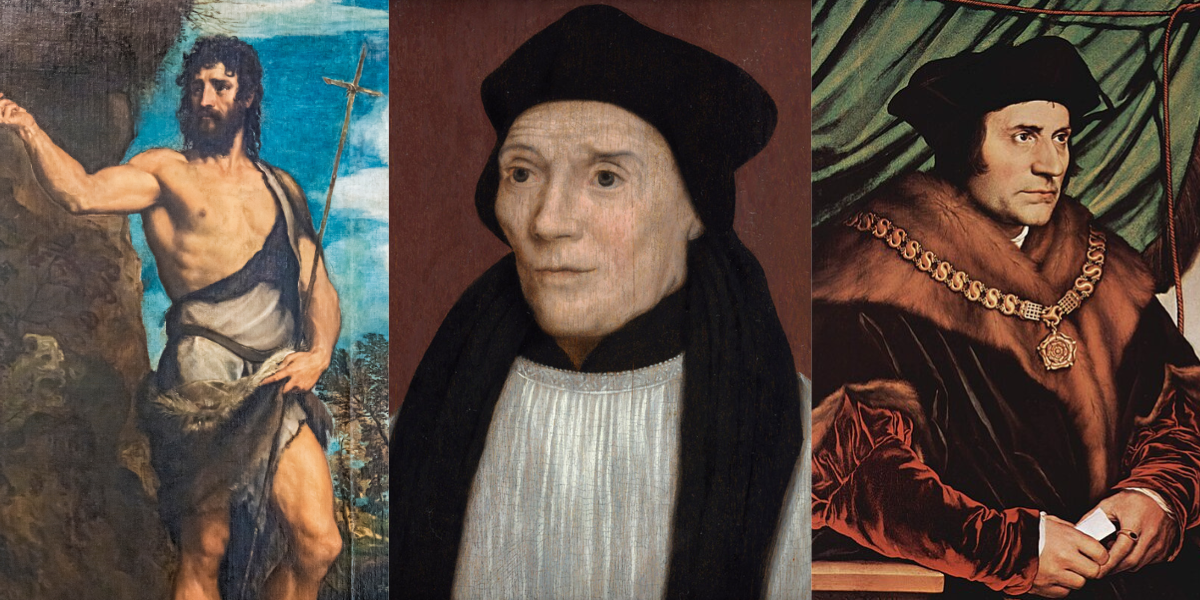
Last year, we noted in this newsletter the complementary vocations of the two English Renaissance giants and holy martyrs: Bishop John Fisher and Chancellor Sir Thomas More.
Pope Pius XI, in his homily for two English martyrs in 1935, called them “beacons” of conscience and virtue in the dark world of the 1930s.
“They, the bright champions and the glory of their nation, were given to the Christian people, in the words of the prophet Jeremias, ‘as a fortified city, and a pillar of iron, and a wall of brass’ … They could not be shaken by the fallacies of heretics, nor frightened by the threats of the powerful.”
They are also connected in many ways with the witness and martyrdom of the Baptist. In a detailed homily on the Nativity of St John, St Augustine notes that the Baptist’s birthdate is rightly famous and was a well-established liturgical feast even in his time. Augustine asks: “Why then did John come? To show the way of humility, so that the presumption of man might be diminished, the glory of God increased. Therefore, John came great, commending the great; John came, the measure of man.”
All three martyrs across time were executed defending the importance of the truth about marriage to the power of the rulers of their times. The Baptist condemned the adultery of Herod Antipas. St Thomas More gave a silent protest to King Henry VIII’s divorce of his Queen, Catherine of Aragon, and the Bishop John Fisher being alone amongst the English Bishops in standing by the Queen and defending her marriage and integrity.
Each man, the two Johns and Thomas, had fascinated and endeared themselves to these kings. We know that Herod was attracted and drawn to John’s personality and witness. John Fisher in his great revival of learning at Cambridge University was a patron of Henry’s mother and a great model for Henry’s own humanistic studies.
It was said that Henry VIII had at first planned to have the holy ascetic John Fisher beheaded on the Nativity of St John the Baptist, but feared that this timing would add to Bishop Fisher’s renown in the hearts of the faithful.
All three of the great martyrs were also witnesses of moral and religious conscience, that is of “true conscience” as a witness to natural law and to God’s law not understood as a position of “self-will”.
As the judge and author Robert Conrad writes of a study of both Fisher and More:
“[More and Fisher] were not adamantine followers of self-will but servants of the one true God who spoke through his Word and his Church. Their shared conviction was that … God was truth, and that his Church was a truth-telling institution.”
Desiderius Erasmus (1466-1536), the Dutch scholar and the third great Christian humanist along with the saints of this memorial day, was horrified by Henry VIII’s reckless and feckless execution of two such great men who had been intimate friends to both Erasmus and the King of England:
“The Bishop of Rochester and of Thomas More, who was the chief magistrate of his country, whose heart was whiter than snow, a genius such as England never had before, nor ever will have again, a country by no means lacking genius.”
YPAT 2026
There are limited places available for YPAT 2026 (Young Political Advocacy Training), a multi-day residential training program for young adults aged between 18-30. Participants gain the knowledge and the tools they need to make a difference – exploring politics, culture and society through topics like ethics, practical politics, leadership and governance, economics and history – all while making lifelong friends.
Partial sponsorships are available.
When: July 3-8, 2026
Where: The University of Queensland, Brisbane
Cost: $600 (including the program, food and accommodation) or $300 (no accommodation and breakfast)
Please spread the word and encourage young people to apply here before they miss out.
Anna Krohn
Executive Director
Thomas More Centre