
A recurring theme at all our Thomas More Centre events over our last three years has been about refining what Christian faith and the faithful have to offer our society and culture.
What makes Christian anthropology, Christian humanism, Christian virtue, Christian community so distinctive, so perennial and so important in our times of disorientation, upheaval and war?
G. K. Chesterton considered that some Christian saints are pivotal not only for the Church but for the world – one being, in his view, St Thomas More: “If there had not happened to be that particular man at that particular moment, the whole of history would have been different.”
A human person transformed and saturated by this grace of being free and responsive to immersion in Christ is described by the great ressourcement French Oratorian theologian, Pére Louis Bouyer (1913-2004) as being “noble of soul”.
To be “noble” in this sense is to be irradiated and transfigured by a rich constellation of qualities Bouyer calls in French “noblesse” and sometimes “noblesse spirituelle”. Simply put, this nobility is the fruit of holiness.
Noble holiness for Bouyer is not simply a moral excellence, not merely aesthetic refinement and is not merely a product of inheritance or “breeding”. Nor is this understanding of nobility individualistic, jingoistic, remote or simply otherworldly; rather it brings about a powerful tide of divine charity and form in the Church and in human history.
Often this “spiritual nobility” is best understood not by lists of definitions, but by encountering such graced nobility in the flesh, in the person of one who is spiritually noble.
Professor Tracey Rowland, a tireless patron of the TMC, has also illustrated examples of “spiritual nobility” from her own life and from contemporary times, particularly in her 2024 book Unconformed to the Age: Essays in Catholic Ecclesiology launched by the TMC at St Peter’s Parish, Toorak last year and in her earlier work Portraits of Spiritual Nobility (Angelico, 2019).
It is notable that in the small but significant public revivals of Christian pilgrimage and devotion, the saints of a place, the peoples’ heroes of “spiritual nobility” have particularly captured the imagination of the converts, cradle Catholics and reverts. The Blessed Virgin Mary in her beloved local titles in many places, St Joan of Arc in parts of France, St Cuthbert in the north of England, St Olaf in Norway and St Catherine of Siena in Italy and across Europe are well-known examples.
One of these national “spiritual nobles” who is less well known to English speakers is a truly remarkable one for TMC and the whole world. He is an apostle of God’s intimate, abiding and merciful love.
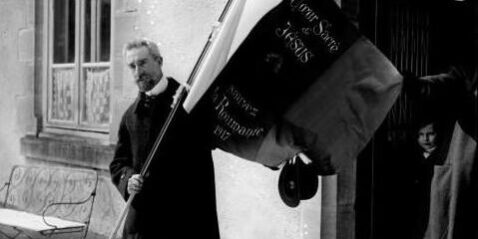
Blessed Monsignor Vladimir Ghika was a Romanian martyr-priest, beatified in Bucharest on August 31, 2013, who became known as the “Romanian St Vincent de Paul”.
Ghika had a richly integrated liturgical understanding of Christian mission. He wrote: “The task of charity, universal and without set times, is only the dilation of the Mass to the day and to the entire world and like the propagation of concentric waves around the Sacrifice and the morning Communion. You are going to take to this poor one, where you have to see Christ, a little of the soul of your Communion and of the virtue of the Sacrifice of which you just partook.”
Ghika has at least five distinct phases in his heroic vocation. At different stages he was a papal diplomat, a lay missionary, friend to the poor, a medical reformer, an authentic ecumenist, a mission priest, a scholar, an original spiritual writer and something of a “wonder worker”. He was the first bi-ritual priest to celebrate both Latin and Byzantine liturgies in Romania.
He travelled extensively to battle zones, cholera outbreaks, to Congo, Japan and even Sydney (for the Eucharistic Congress in 1928). When he arrived in Melbourne, several Australian journalists were intrigued by the “picturesque” sight of a tall, mysterious, long-haired priest/prince in a black cassock.
Ghika was born in Constantinople (Istanbul) into a French/Romanian Orthodox diplomatic and princely family as “Prince Vladimir”.
In 1902 he entered the Catholic Church, considering himself always Catholic. He studied with the Dominicans at the Angelicum and studied law, medicine, theology and botany. He was able to converse in 22 languages.
In 1923 before the relics of St Vincent De Paul in Paris, after working for the Popes in missionary travels he funded himself, Vladimir was able to fulfill his long-held desire to serve as a Catholic priest and was finally ordained. In Paris he was part of the rich revival of Catholic and Eastern intellectuals, becoming friends with Jacques and Raissa Maritain, Fr Garrigou-Lagrange and other friends including Paul Claudel, Francis Jammes and François Mauriac. Today, Blessed Vladimir’s relics are contained in the recently restored altar of Notre Dame in Paris.
Once ordained, he deepened both his missionary and charitable work in the destitute slum region of Paris, Villejuif. He developed a rich spiritual thread to his work, which inspired many lay Catholics.
“After his ordination, he established the ‘Association of Brothers and Sisters of Saint John’, dedicating himself to serving the poor in the suburbs of Paris. Notably, in 1903, he created a personal rule of life based on the Franciscan and Dominican rules, which he knew well as a tertiary of both mendicant orders.”
In 1939 he returned to Romania to serve there and refused to leave the country on the King’s royal train into exile. After the war at the age of 79, he was made a political prisoner by the communists. His captors inflicted regular appalling tortures to force him to denounce his faith and his loyalty to the Pope. He was burned, savaged by guard dogs, starved and beaten. Discovering that he had prayed not to be hanged, the captors subjected him to fake hangings over 83 times.
Throughout all this hell, Fr Vladimir was an extraordinary living “Christ” amongst the prisoners. He died from the monstrous inhumanity meted out upon him in 1954 on May 16, his recently honoured memorial day.
Tracey Rowland in her most recent book, featured recently at the TMC launch in Melbourne, cites a reflection by Blessed Vladimir Ghika on the fly leaf of her book:
“God watches over His children at night. He is the great watchman of all nights, nights of the flesh, of the intelligence, of the heart, nights of evil where shadows descend at all hours upon suffering humanity. Who can say with what love He watches over us in this Night? This love has a name and a quality. It is infinite love.”
Blessed Vladimir is surely a powerful intercessor and living inspiration for our quest at TMC.
Anna Krohn
Executive Director
Thomas More Centre
Featured image: Vladimir Ghika is carrying the emblazoned banner of the Sacred Heart of Jesus of Romania. Taken from Wikimedia Commons. Public domain.


.jpeg)