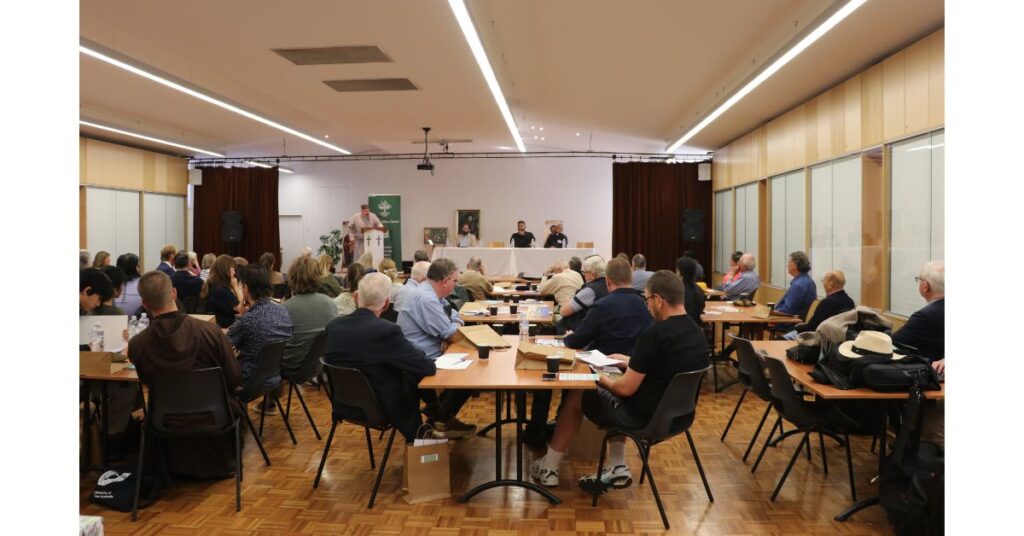
To wrap up such a lively and momentous experience as last weekend’s TMC Summer Conference, “Christianity and the Common Good”, is a challenge.
This week our TMC teams are aiming to “value-add” and share the wealth of content and insight from the conference with you, our readers.
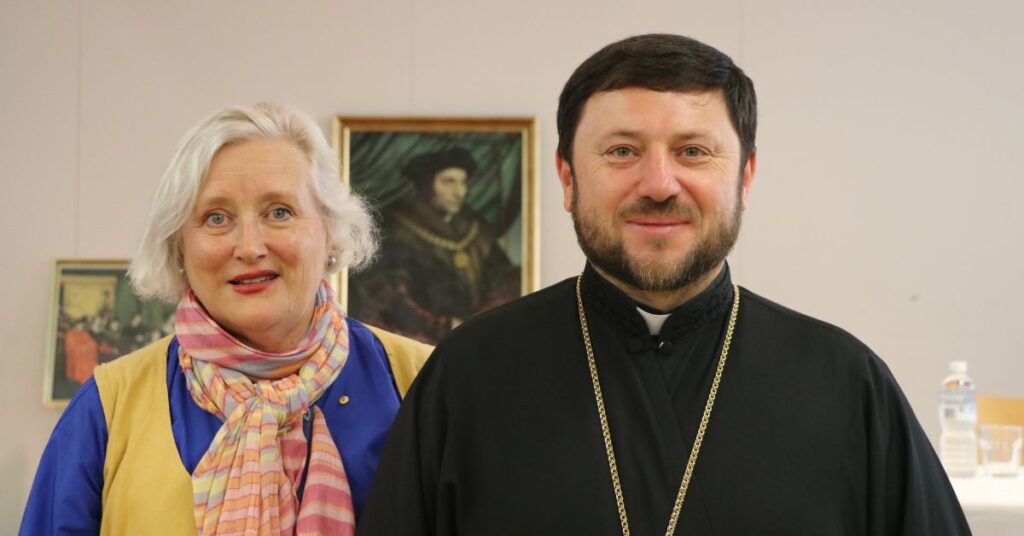
The day was refreshing, because it was deliberately technology “lite” and off-screen. This counteracted the whirr of social media by providing real time and space in which people and speakers could meet, pray, think, eat, exchange ideas and share company.
It is rare to attend a conference about such a meaty topic – Christian faith and the common good – and to hear that guests and speakers found the day “great”, “enjoyable”, and even “fun”.
Credit: C Krohn
Credit: C Krohn
At the conference dinner, former prime minister the Hon. Tony Abbott AC jumped off the stage, microphone in hand, to honour his mentors and guides as well as to speak about his latest and best-selling book, Australia: A History (2025).
One great highlight for which we are inspired and grateful is the community at the Ukrainian Catholic Cathedral of Saints Peter and Paul in North Melbourne, with Cardinal Mykola Bychok, Vicar General Fr Simon Ckuj, and his Chancellery engaged in the conference program and were warm in their hospitality and support for the conference.
The conference was blessed by wonderful people: remarkable speakers, panellists, volunteers, helpers and participants who not only came but engaged in such animated conversations and good company.
Our plan was to offer a concrete demonstration of what the American Catholic philosopher and theologian, Michael Hanby, calls the “first” place of metaphysics, theology and liturgy in any realisation of the common good.
Hanby is a striking critic of our post-liberal and post-secular societal flux.
He is the Associate Professor of Religion and Philosophy of Science at the John Paul II Institute for Marriage and Family Studies at the Catholic University of America, and author on Bishop Robert Barron’s Word on Fire website.
Hanby has been arguing that “politics” without a transcendent and metaphysical grounding “cannot save us”. He has linked the rise of surveillance and virtual technology with the abject decline of the rational in politics.
Hanby writing BC (Before Covid) sees that:
“The post-political age, by contrast, is marked by the triumph of technological society over political society and is ultimately “governed” by technologically driven processes deeper and more extensive than the rule of law, processes which simply bypass rather than destroy the hollowed-out institutions of a decadent political society.”
Without a metaphysical or theological beginning and “end” for the human person, the common good is impossible.
Hanby writes more recently in the New Polity journal:
“Political life, to borrow a term from Maurice Blondel, is ‘metaphysics in action’: and every metaphysics, even one in action, implies some tacit conception of God – what God must be if the world is really like this – irrespective of whether he is thought to exist.”
Heeding this fact, we aimed to make this TMC conference accessible and humane in an integrated, not merely an intellectual, sense.
We wanted a discussion about the Common Good that fed the soul, the mind, the heart and the body, and we think in so many ways the conference did this.
Our souls were greatly edified by the Cardinal’s witness and words. He said:
“Before we speak of policies, structures, or social strategies, we must speak of prayer. Before we attempt to build a just society, we must allow God to build within us a just heart.”
The Ukrainian Eparchy’s Vicar General Fr Simon Ckuj re-orientated the discussion of the Common Good and grounded it in the Christian life of prayer, liturgy and virtue.
Paying tribute to B.A. Santamaria, St Thomas Aquinas and the current Patriarch of the Ukrainians, Fr Simon pointed out:
“If the Common Good is rooted in the truth about the human person, then prayer and liturgy are not optional. They are essential. They shape the heart, purify the conscience, and open us to the grace that makes communion possible. His Beatitude Sviatoslav put it simply: ‘Without prayer, the Christian becomes spiritually disarmed. Without liturgy, the Church becomes a mere organisation’.”
Session One’s panellists Fr Nicholas (Collin) Nunis and Deacon Ferdinand Correya integrated these themes by offering warm pastoral reflections on the family and education.
Our bodies were given the treat of delicious and bountiful meals served by the smiling and expert catering staff under the direction of Bernie Girolami (Bernie’s Fine Foods), and the conference dinner was greatly enhanced by the care and quality of their cooking straight from the kitchen and by our hard-working volunteer hosting team: Ann-Maree, Brendan, Rosie and Sam.
Our minds were given excellent fare as well. Fr Jerome Santamaria gave us a masterclass on the richness of the measure of “flourishing” in discerning the Common Good. Rather than rely on sociology or political theory, Fr Jerome directed the discussion to the Biblical creation narratives “which present humanity as an icon of God. I believe this picture gives us three criteria of when humanity flourishes and therefore three criteria for discussing different visions of the common good. The three criteria are: 1) order, 2) life, and 3) communion.”
Panellists Aaron Russell and Gabriel Tipnis extended this discussion from the life of working lay men.
The final session pushed our imaginations into the realm of serving the polis in action and vocation. This section tackled the tough questions of political reality, prudence, discernment and virtue.
Hon. Christine Campbell, former politician and leader in the care of mothers and children, led the session with lively discussion from current MP Brad Rowswell, Andrew Mathieson and Joseph Doyle.
The dinner was full of memories, friendship and great heart with Tony Abbott and the two young chairs, Paniny and Augustine, underlining the importance of mentors, examples and a true account of history.
The presence of our generous patron Professor Tracey Rowland and her husband Stuart reminded us of reality as “a gift” with her door-prize gifts of her recently published book.
The shared Byzantine Vespers led by the Cardinal, Fr Nicholas Nunis, TMC servers and choir integrated the heart, mind, soul and body as a fitting highlight to the day.
Your continued support matters a great deal. Your thoughts, expertise, and financial support will make that happen. Please consider making a donation here.
As the Ukrainians sometimes say,
Велике спасибі! (Huge thanks!)
Anna Krohn
Executive Director
Thomas More Centre