1. 100th Edition of the Thomas More Centre Newsletter
It is hard to believe that we are into the second week of Advent 2025 and that this is our 100th edition of the Thomas More Centre newsletter.
Huge thanks to so many of our readers for sending emails, texts and even in-person comments of appreciation over the times since we began in October 2023.
Thank you for responding to topics that you have found fascinating, encouraging or even puzzling. Thanks to those who have signed up to donate funds on a regular basis to support the newsletter. As we try to rebuild our resources, this provides very welcome support.
Your support and comments remind us that you are part of a living and important community.
We have discovered some messages from our readers had automatically been diverted to other in-trays. Apologies if your message has been languishing in the “valley of spam”! My project is to reply to all of these in the week ahead.
When the concept of a regular electronic newsletter first arose, I realised that it needed to be more than a dry bulletin. In a way, it needed to serve as a small reflective oasis – succinct enough to be read over a cup of tea but meaty enough to launch you on a mini-pilgrimage of the topic, news item or person that sparked your interest and highlighted some of our interests here at TMC.
The newsletter opens a window onto Thomas More Centre activity and developments. Next week’s newsletter will provide a bumper news edition about various events during November and December this year – stay tuned!
2. Marian Protection & Pilgrimage: New and Old World
Speaking of pilgrimage and Advent, this week marks in the Catholic tradition two feast days associated with the Virgin Mary’s role as intercessor and intermediary for Christians, which both attract not simply thousands but millions of pilgrims each year. Many of these pilgrims are of course Catholic, but they also include many other Christians and those of other and uncertain faith.
Both feasts this week not only attract the devotion of the Catholic faithful, but they also provide links to biblical mystery and personal wonder leading up to the celebration of Christmas.
2.1 The Old World Shrine
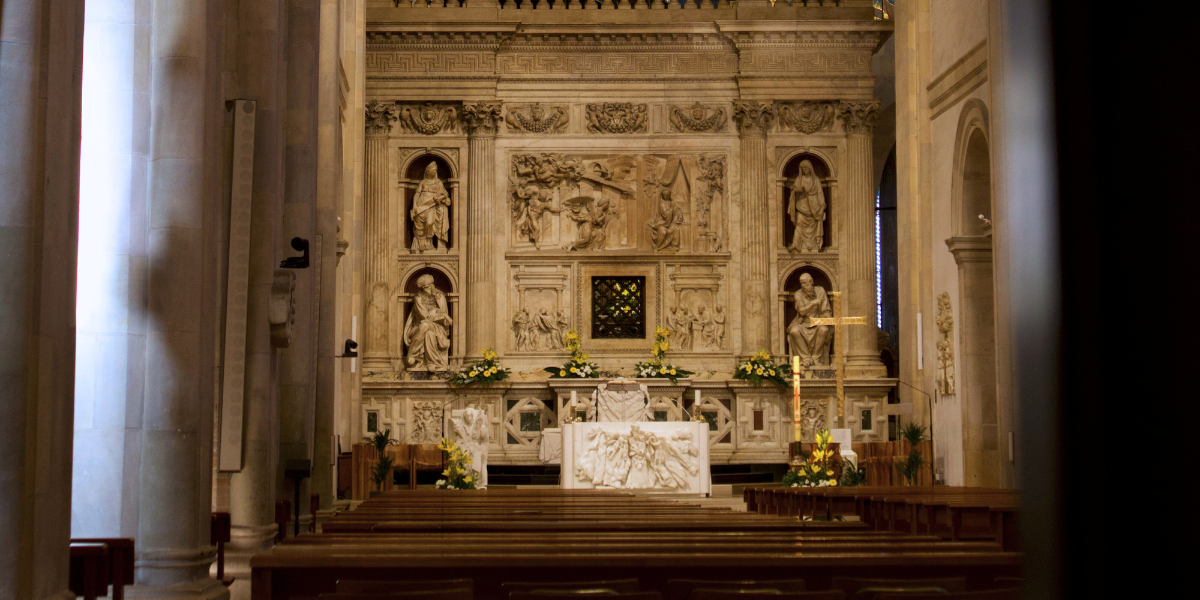
December 10 marked a celebration of a medieval and European holy place – the Holy House of Nazareth in Loreto in Italy.
Each year many millions of people travel to the site and the special basilica, which houses a tiny building structure believed to have been rescued and transported in the 1290s from the Holy Land, which had been overrun by destructive Islamic military forces, to the town of Loreto in the Marche region of Italy via the region of Dalmatia.
The simple, rustic and tiny structure was according to tradition the very building in which Jesus Christ was conceived and lived as a child in Nazareth. It therefore stands as an unusual sacred relic, which is a building in which were present the first moments and unfolding childhood of the God who “put up his tent amongst us”.
The original structure evoked the humble life of the Holy Family in their homeland, and this fact has appealed to the thousands and then millions whose own families lived and still live today in a similar way.
Today, the “Sancta Domus” is encased within a richly decorated basilica, which welcomes the millions of pilgrims, noble and simple, who visit there each year and in which liturgical celebrations take place. You can glimpse an aerial view of the shrine and explore the wealth of celebrations associated with the Holy House here.
For all its glory, the basilica contains the first little house as a domestic Church. As the writer Marcia Pointon writes: “Thus the basilica is a kind of giant reliquary within which the walk-in relic of the Virgin’s house, an architectural feature in its own right, is protected and celebrated.” (‘The treasury of the Santa Casa at Loreto and its English visitors’, in Brilliant Effects: A Cultural History of Gem Stones and Jewellery, 2008)
One historical account suggests that the building was brought by angelic power. There may be a more human genealogy: “In 1900 a priest found records in the Vatican archives indicating that a Byzantine Greek family named Angelos – which translates to “Angels” in English – rescued Mary’s home during the Muslim conquest of 1291.”
2.2 The New World Shrine
The second great shrine and feast was established in the Americas, in the “new world”, and it sits in the Mexico City area of Guadalupe. It is the most prodigiously visited Catholic shrine in the world today. It is reported that between 18 to 20 million pilgrims visit the shrine each year.
The site marks the encounter during the days between December 5-12, 1531, of a radiant “dark heavenly mother” and the Aztec Christian, Juan Diego Cuauhtlatoatzin (“talking eagle”), who was canonised by Pope St John Paul II as St Juan Diego in 2002.
At first, Juan Diego’s messages about the glorious lady and her desire for a shrine to be built in Mexico were received with reluctance and disbelief by the local missionary Spanish bishops and clergy.
Juan Diego was over 50 and one of the first generation of Christian converts in the region. Juan was recently widowed but lived a hidden life of prayer, sacraments and good humble good works. He found it hard to believe the appearance himself.
He asked the glorious woman for a sign of her reality. Through God’s power, a type of icon of the Mother was imprinted miraculously on Juan Diego’s tilma, his native cloak made of cactus fibre, and he delivered to the Church authorities a huge array of Castile roses that were entirely out of season in Mexico.
There are many remarkable aspects to the icon of the Virgin Mary, which have deep resonances with the signs of the Woman of the biblical book of Revelation and with ancient Mexican culture. Modern cultural and archaeological scholars have noticed for instance that the 46 stars on the mantle of the Woman are exactly the configurations of stars that appeared in the Mexican sky at the time of the appearance.
The image and the tilma made of such fragile cloth remain preserved today.
The pilgrimage site has become associated with the evangelisation and importance of native peoples and with the protection of the unborn.
Pope John Paul II discussed this on his papal visit to Mexico and Juan Diego’s canonisation:
“‘The Guadalupe Event’, as the Mexican Episcopate has pointed out, ‘meant the beginning of evangelisation with a vitality that surpassed all expectations. Christ’s message, through his Mother, took up the central elements of the indigenous culture, purified them and gave them the definitive sense of salvation’ (14 May 2002, No. 8).”
Despite the Protestant and Whig foundations of the Republic of the United States, President Trump this week issued a statement from the White House underlining the importance of the Virgin Mary to peace in the world and noted the importance of Our Lady of Guadalupe.
3. Advent/Christmas Treat – The Poetry of Daniel Mitsui
Just in time for Advent, our Thomas More Centre organiser Mark Makowiecki has just today released his interviewwith the fascinating and prolific artist in many media – Japanese-American illustrator, typographic designer and poet: “Daniel Mitsui – His Poetry, the Truth of Catholic ‘Legends’, Advent and Christmas Customs”.
Daniel is a man of great learning and curiosity, and he has managed to inject his own Japanese heritage into the hieratic language and symbolism that has fed his fascination with medieval sensibilities about “devotion, liturgy and writing”.
In this interview Daniel talks of his collaboration with his wife Michelle, who is a musician.
You can hear here Daniel read and discuss one of his poems, which uses the rhythm and rhyme pattern of English poet Rudyard Kipling.
In this podcast, Daniel also discusses the fusing of the inspiration from the Arts and Crafts Movement on his imagination and the Catholic artist David Jones.
Blessings for the second week of Advent!
Anna Krohn
Executive Director
Thomas More Centre
Featured image credit: Nicole Yap