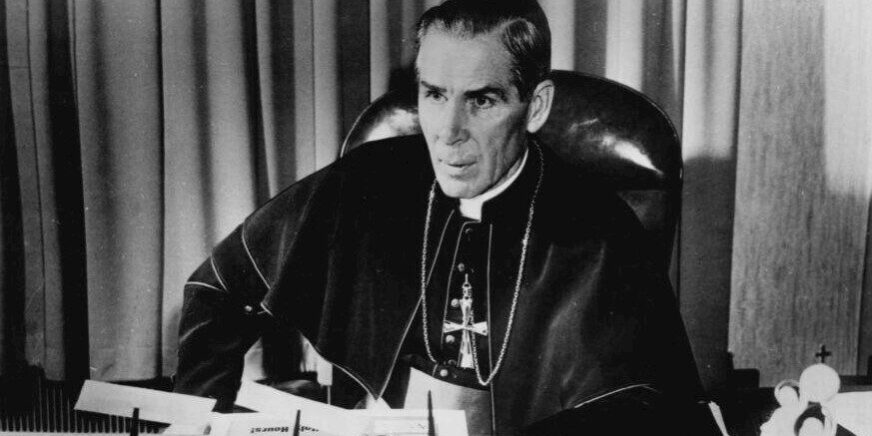
It is difficult for us in an age of Snapchat and X and with options in fast travel to realise the time, effort and excitement involved in the May 1948 visitation of a 15-member American ecclesial delegation to Australia.
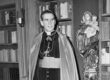
What made this visit exceptional is that it enabled the broadcasting sensation, the then Monsignor (now Blessed) Fulton Sheen, to speak before huge audiences in person and then to conduct numerous radio broadcasts – sometimes on the fly.
In 1929, the U.S. Conference of Catholic Bishops had asked Fulton Sheen, already a compelling teacher, preacher and scholar, to dedicate his talents to radio evangelisation.
In 1930, only 11 years after his ordination as priest, a landmark radio channel was created in order to broadcast Fr Sheen’s The Catholic Hour. Sheen attributed his immediate and dramatic radio style to the lively and witty BBC radio work of G.K. Chesterton.
The Catholic Hour was broadcast every Sunday night for 20 years and at the height of its popularity reached over 5 million listeners. Published transcripts, tapes and re-broadcasts had already made Sheen a worldwide star.
Many older and now younger Australian priests attribute the spiritual shape of their prayer to the Venerable Fulton Sheen’s advocacy and example of a daily Eucharistic Holy Hour.
In his astutely humorous and self-deprecating autobiography, Treasure in Clay (1979), Sheen, by then elevated to Archbishop, looks back on his Australian adventures.
He writes of the relentless pace of the visitation and the 7,500 miles of probably multi-stop and relatively unpressurised air travel:
“The very first night of our arrival in Sydney, I addressed 25,000 people inside the cathedral (St Mary’s) and another 15,000 heard the sermon through loudspeakers outside. The next morning I gave four broadcasts.”
As part of the Archdiocese of Melbourne’s centenary celebrations, the Archbishop of Melbourne, Dr Daniel Mannix, had invited Monsignor Sheen and the New York Cardinal Francis Spellman to an even more monumental series of well-attended events.
Sheen recalls catching a tram to address a public meeting at the Brunswick Town Hall. He sought direction from a local newsboy telling him that he was giving a talk “about how to get to Heaven” and the boy cracked back, “How will you do that, since you don’t know the way to the Town Hall!”
He and the cardinal joined many dignitaries in a huge Centenary Mass at St Patrick’s Cathedral and an open-air Mass at Caulfield Racecourse, attended by nearly 100,000 of the faithful. There was a ball at the Melbourne Town Hall, numerous radio broadcasts and even school talks.
The highlight of the Melbourne leg and probably the most controversial was Monsignor Sheen’s address to a Centenary Men’s Night at the Royal Exhibition Building in Carlton.
The evening included a program of prayer, the celebration of Mass and a talk on the state of the world and role of communism. The talk and responses to the talk were widely covered in both religious and secular newspapers.
The Adelaide Catholic paper, The Southern Cross, painted an evocative account of the night. The writer noted that “the vast hall” was filling with 25,000 men, some walking through a wet Melbourne night, “sometimes straight from work”.
The men “were both disciplined” and in full voice, singing along to a choir led by the legendary choir director Dr Percy Jones. The article continued, “the hall was bright with banners” and the flags of parish lay sodalities.
Sheen in his autobiography commented that in addition to the men in the large Victorian hall, “15,000 were listening in loudspeakers outside”.
Melbourne’s Frank Murphy of The Catholic Advocate commented that Dr Mannix was well pleased by the enthusiastic rallying of lay people. Murphy noted, “For many years various forms of Catholic Action have been firmly established and are producing consoling fruits amongst the working classes.”
Sheen notably addressed the post-war situation of the world, grounding his bon mots and memorable phrases in a thoroughgoing immersive study by him into the sociology, psychology and philosophy behind the prevailing and tempting ideologies of the time, including the writings of Marx, Feuerbach and Freud.
In his address, Monsignor Sheen walked his audiences through anthropological errors of Marxism and what he called “monopolistic capitalism”.
He explained that the thinking behind each of these systems, especially communism, “rose out of the secularised remnants of Western civilisation whose soul owes so much to Christianity”. He would later comment, “Communism begins where atheism begins.”
He described the problem of “historical liberalism which views freedom as a physical power rather than a moral one”. Both ideological poles, he explained, are based not only on a faulty view of civics but on an erroneous view of the human person and cosmology.
The Catholic Church, he said, is not “anti-Russian” in some chauvinistic sense, nor does it hate Russian people. Indeed, Sheen would become the first U.S. Latin bishop to be bi-ritual – to celebrate the liturgy in English in both the Byzantine and Latin traditions.
Rather, he insisted, the Church opposes the reductionism and totalitarianism of communist systems because they “will be harmful to you religiously, economically and politically”.
The same sort of envy and resentment which feeds capitalistic greed and the secular status quo also fuels the class warfare of communism. Monsignor Sheen quipped, “A communist is just a capitalist without money in his pocket.”
Many lay Catholics were ignited by Sheen’s talks, and there were calls for more careful study of the issues he had raised. B.A. Santamaria noted the interest amongst many Catholics in studying the connection between philosophy and politics.
At the time, though, both the sectarian and Marxist news outlets were hot with anti-Sheen rage.
Brisbane’s anti-Catholic paper the Clarion dubbed Monsignor Sheen “a papal agent … a Romanist propagandist … and the spear-head of the Catholic Actionists!”
The communist publications argued that the Catholic evangelist was “perpetrating myths about Marxism” and that he was “a fanatic of the most violent kind”. American Marxists argued that Fulton Sheen should be charged with treason.
In the face of such vitriol, the stakes about worldviews were high in 1948 and involved Australians of all classes.
At the time in 1948, the world tottered with instability. The year began with trouble.
In January, Mahatma Gandhi was assassinated. During this year the Israeli-Arab war began. Communist forces were working on revolution in many places destabilised by the wreckage of the World War and the collapse of old imperial structures. In June the Soviet Union blockaded all of Berlin and in February communists with Soviet backing took over the Czech government.
Australian communist unionists worked with Indian Marxists to influence 1948. Communist activists dominated the elections and industrial actions of unions in the transport, mining and maritime sectors.
One older family member recalls the rust on the unused railway tracks due to the long railway strikes in 1948. The Labor Prime Minister, Ben Chifley, struggled to balance the genuine labour concerns against power of the communist activists.
B.A. Santamaria comments on the vigour and interest by ordinary Catholics in these debates in Australia. At the time, writing as assistant researcher to the Australian Catholic Bishops’ Secretariat, especially in their Social Justice Statement entitled Socialisation (see image below), he comments that over 200,000 copies of the pamphlet had been sold in Australia.
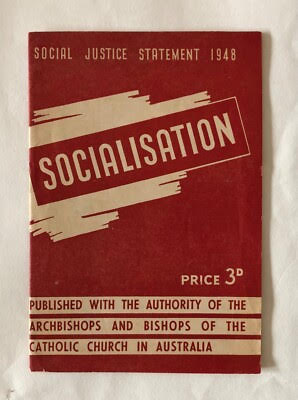
In this, B.A. Santamaria was like Monsignor Sheen arguing for a “social co-operation” which upheld and promoted the “mediating” dynamics of the family, the small and medium businesses and industries and the importance of rural communities.
This “third way”, he argued, was the Christian response to the socialist call for widespread state ownership of all resources and institutions. The Bishops’ approach also defended the place of some Commonwealth ownership in areas such as defence, superannuation and some energy resources.
1948 in part opened a new era in which the analysis of Monsignor Sheen and the thought of the Catholic Social Movement prompted a united and engaged Catholic imagination.
Anna Krohn
Executive Director
Thomas More Centre
Featured image: Public domain