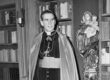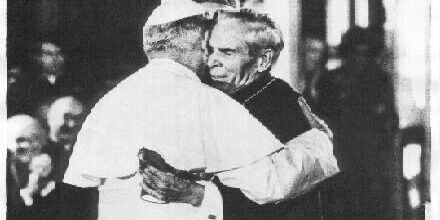
Above image: Archbishop Fulton J. Sheen embraced by Pope John Paul II (October 2, 1979). From papalartifacts.com.
A particularly arresting image revived during the recent beatification celebrations for the great American evangelist, Archbishop Fulton Sheen, is that of the frail American Archbishop being lifted and enveloped by the young and vigorous Polish Pope John Paul II.
The striking moment is captured in grainy black and white stills and in blurry video. The moment took place in New York’s great St Patrick’s Cathedral on October 2, 1979, during John Paul II’s highly charged first visit to the United States.
It is timely to recall this meeting and those times, as the Church’s Memorial Day for the now sainted Pope John Paul II is October 22, marking the anniversary of his election as Pope in 1978.
The meeting occurred at a time when Cardinal Terence Cooke was Archbishop of New York and Jimmy Carter was the U.S. president. Just prior to his six-city trip (October 1-8) to the United States, Karol Józef Wojtyła as the new Pope had already carved his global presence with a tour of Mexico in January and to Poland in June while the country was still under communist rule.
The “Polish pilgrimage” is sometimes referred to as the “nine days that changed the world”, as it galvanised the rise of the Solidarity movement leading to the eventual bloodless tsunami which overtook the Soviet regime.
Those who know the story of Archbishop Sheen will know that at the time of this meeting, Fulton Sheen – the man who had been a mega-star of media, of the podium, preaching and of publishing from the 1930s to early 60s – had just returned from a period of near-exile as a result of the displeasure of the powerful institution-building Cardinal of New York Francis Spellman (1889–1967).
By 1979, even many in the Catholic world seemed to have forgotten the media giant and he almost shrank back behind the assembled bishops and dignitaries in the Cathedral.
In a totally unstaged way, the elderly Archbishop fell to his knees before the Pope who sought him out. The two men shared so many characteristics as philosophers, evangelisers, Christo-centric preachers and masters of dramatic timing and impact.
The Pope said while grasping him up under the arms: “You have written and spoken well of the Lord Jesus. You are a loyal son of the Church.”
Archbishop Sheen would live another two months, dying kneeling during his lifelong Holy Hour before Christ in the Blessed Sacrament on December 9, 1979.
The photos capture perfectly not only the emotional and human drama but also what an ecclesial, cultural and spiritual drama looks like. Some have written that it was like a passing of the torch between the two leading communicators of two eras.
In our most recent TMC newsletter, we were delighted to share Professor Tracey Rowland’s tribute to Blessed Archbishop Fulton Sheen and his importance to her own ecclesial, academic and personal outlook on life.
Professor Rowland notes that one of the distinctive qualities of Archbishop Sheen was that his life’s works were deeply grounded in an intense study and contemplation of the metaphysical dramas amid modern culture.
She points out that Fulton Sheen was not just a moralist, a catechist, author or philosopher (though he was all of these), but:
“He was a spiritual pathologist. He did not criticise those who were without faith or had acquired faith in idols, he tried to show how they got to that position and how being in that position would not end happily. He was a master at investigating and then highlighting the theo-dramatic quality of human life.”
Now, some readers may be unfamiliar with the terms “theo-dramatic” or “theo-drama”.
It describes a very scriptural and traditional reality, but it was described in this particular way by the Swiss theologian Hans Urs von Balthasar (1905–1988) of whom Professor Rowland is a scholar.
Von Balthasar’s aim was to illustrate through his expansive theological and analogical aesthetics that God, His grace and His glory could not be reduced to being the product of human ideology, thinking or desire, as many modern philosophers and sociologists were wont to argue.
Navigating helpfully between the dense Germanic sweeps of von Balthasar’s cultural exegesis and the Thomist and Patristic traditions is the work of the English Dominican Fr Aidan Nichols, particularly in his helpful Balthasar for Thomists (Ignatius Press, 2020).
Fr Nichols writes: “For God’s revelation is not an object to be looked at: it is his action in and upon the world, and the world can only respond, and hence ‘understand’, through action on its part.”
Von Balthasar unfolded in his monumental studies the fact that cosmic and human history is reality, a living rather than performative drama, in which God is active as the Director and the Producer and in which we are called as flesh and blood actors.
Our lives are therefore a life and death drama of real mystery and meaning.
As the Hebrew Scriptural tradition pursues so emphatically, we are not mere chess pieces in a master plan but are called “by name” or, as von Balthasar explains in the Prolegomena of his giant theological trilogy, “only in Jesus Christ does it become clear how profoundly this definitive ‘I’-name signifies vocation, mission … far beyond anything attainable by earthly means”.
We are called to be in each moment receptive and active in Divine Salvation History in our own human uniqueness. This can only be fulfilled by our participation in the joyful freedom which is purified by the Cross and Paschal Mystery of Jesus Christ and in the hope of life in the Blessed Trinity.
The stakes are enough to help us to exclude apathy, mediocrity and doom-scrolling amnesia. This was of course what Pope St John Paul II pleaded during his World Youth Day addresses.
Archbishop Sheen would in similar vein write:
“We are responsible to the times in which we live and on judgement day, teachers will not be asked how many skeletons they exhumed from the past and re-buried in the dust, but how well they served the cause of the truth in the days of their flesh.”
What a challenge for our work with the Thomas More Centre!
Anna Krohn
Executive Director
Thomas More Centre