As well as bringing the spring and her welcome rains to our region, the last few weeks of September have also brought some bright lights of hope to the Church.
The impact of the huge attendances (a total estimated between 1.5 and 2 million men, women, children and many babies) and warm responses to Pope Leo XIV’s tour to France (September 25-28) is still to be gauged in time and effect.
However, when news sources such as Reuters and Al Jazeera are admirably awestruck – it is a sign that something unusual is afoot.
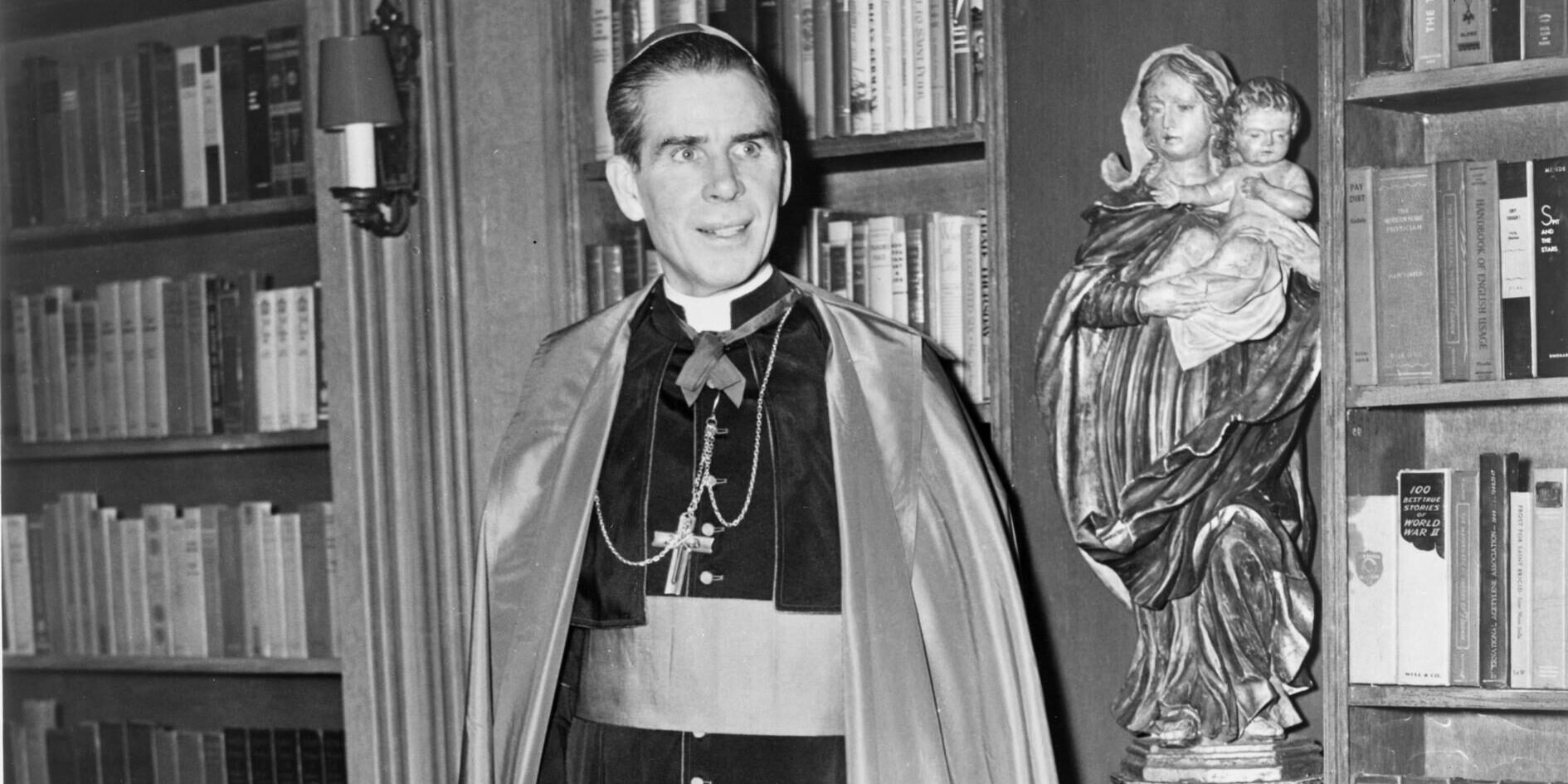
At the same time across the Atlantic, in the stadium of The Dome of the America Centre in St Louis, the Mississippi port city between Missouri and Illinois, 50,000 people along with 1,000 priests and 90 bishops assembled for the beatification liturgy of that pioneer of media evangelisation on a global scale, Archbishop Fulton Sheen (1895-1979).
By any measure Bishop Fulton Sheen is and remains a giant voice and intellect of the Catholic Church worldwide, earning the attention and respect of other believers and non-believers alike.
It is impossible to measure in worldly terms the harvest from the now Blessed Fulton Sheen’s philosophical and evangelising efforts. But even in cold hard statistical terms, he carved a landmark visible from space with his use of the latest media technology of his time: firstly the radio, then prolific print pieces and books, then his improbably popular television shows (Life is Worth Living garnered about 30 million viewers a week!) and into our times through digital platforms such as YouTube.
Bishop Sheen was instrumental in bringing a multitude of people to, and back to, Jesus Christ and the Church. He was also a major influence in the vocations of the current generation of techno-savvy evangelists. Fr Mike Schmitz, for instance, the chart-topping American priest media presenter and speaker, credits the Bishop for his vocation and spirituality.
Over the next two issues of the newsletter we will pay tribute to Bishop Sheen’s legacy. So much of his approach, especially his desire to present a balance between faith and reason, is an inspiration for the Thomas More Centre.
This week’s contribution is by our eminent patron, the theologian Professor Tracey Rowland. She provides a personal and professional appreciation of Sheen and of the parish priest who shared with her cassette tapes of Fulton Sheen’s homilies and talks.
In the midst of 1970s pastoral and social “experimentation” Bishop Sheen was a beacon of common sense and clarity which gave these tapes, she says “a samizdat status”.
Please enjoy!
Anna Krohn
Executive Director
Thomas More Centre
Celebrating Fulton Sheen
I wish I were in Missouri this week for the beatification of Fulton Sheen. In the 1970s my parish priest shared with me his collection of Fulton Sheen cassette tapes. In my mind they held something like samizdat status. Fulton Sheen was my rebel hero who dared to criticise what Joseph Ratzinger called the “infantile claptrap” of 1970s style pastoral experiments.
I remember in one homily he shouted “I want to be me, I want to be free” as he explored the emptiness of the hippie concept of freedom. In another he shouted “get down from the Cross” as he explained that all the projects seeking to make the Church loved by the world share the property of wanting Christ to be more of a philanthropist than a sacrificial victim.
During the era of the Cold War Archbishop Sheen noted that the people trapped on the wrong side of the Berlin Wall and oppressed by governments promoting atheistic ideologies had the Cross without Christ. Conversely, those living in the free world had Christ without the Cross. One had suffering without a redeemer, the other had, or at least desired, a redeemer who didn’t ask for anything in return.
Fulton Sheen’s Catholicism was not a moralism, not another moral code on the smorgasbord for people who wanted to be socially respectable. It was a way of life that centred on participation in the life of the holy Trinity. This meant he was very interested in how God communicates to us and how God is made present in the sacraments.
I remember listening to a tape where Sheen told the story of the conversion of Charles de Foucauld, who became a Catholic priest and hermit living among the Tuareg people in the Sahara. Foucauld has lost his faith as a teenager but his cousin Marie de Bondy implored him to go to Confession. He did so to keep her happy. Once inside the confessional box he told the priest that he didn’t believe and was just going through the motions to placate his cousin. The Abbé Henri Huvelin ordered Foucault to kneel down and make his confession, saying, if you make your confession you will believe!
Foucauld followed the order. He left the confessional box a Catholic, died a martyr in 1916, and was canonised in 2022. Decades after I heard Fulton Sheen tell the story I visited the church of St. Augustine in Paris where Abbé Henri Huvelin’s confessional box was still present and a plaque marked the location where Foucauld’s life took the dramatic course correction.
In another homily on the sacrament of Reconciliation Sheen suggested that when penitents see a priest raising his hand at the moment of absolution, they should imagine that the blood of Christ is dripping from the hand of the priest. For Sheen a priest was no mere social worker or CEO of the local parish but an alter Christus, another Christ. The two places where a priest most dramatically stands in for Christ are at the sacrifice of the Mass and when offering absolution. That image has remained with me over the decades. Whenever I see a priest raise his hand to give absolution I think of it.
Sheen also had a great capacity to read the culture. He could observe what was happening at the level of popular culture and then offer a theological explanation of the spiritual undercurrents driving the social epiphenomena. He was a spiritual pathologist. He did not criticise those who were without faith or had acquired faith in idols, he tried to show how they got to that position and how being in that position would not end happily. He was a master at investigating and then highlighting the theo-dramatic quality of human life.
One also picked up quite a lot of Catholic cultural capital just listening to Fulton Sheen. For example, I learned the meaning of words like “rochet” and “ferraiolo”. I also learned about pontifical degrees and the names of great European Catholic universities. I was somewhat shocked by his story around his agrégé en philosophie exam that took place at the University of Louvain in 1925. The practice was that students would only learn of how they had fared at the social event that followed the public examination. Those who had failed or barely passed would be served water, those who had passed in a respectable way were served wine, and those who were outstanding high achievers were treated to a glass of champagne. Sheen, of course, got his glass of champagne.
I was a young teenager when I heard that story and it really impressed upon me how deadly serious the Church is, or was, about the intellectual side of the faith. When I finally visited Belgium in 2004 the University of Leuven was a very different place. It remains in my memory as the only place in the world where I have ever been to Mass where instead of a homily we were shown video footage of the attack on the world towers three years earlier and invited to reflect upon that. Clearly Fulton Sheen’s Louvain/Leuven was a very different kind of institution.
In the same year that he passed his agrégé en philosophie exam Fulton Sheen spent some time at St. Patrick’s Parish in Soho, London. This parish would later become Cardinal Pell’s favourite place to stay in London. Today the parish priest, Fr Alexander Sherbrooke, is well known for catering for the spiritual needs of both ends of the social spectrum. I have twice been in London for the Feast of Corpus Christi and on each occasion I joined the St. Patrick’s procession that meanders its way through the seediest laneways of Soho and finally ends at an Anglican parish – St. Giles-in-the-Fields – where a number of Jesuit martyrs are buried.
I never visit St. Patrick’s without thinking of Fulton Sheen and wondering what direction my life may have taken had it not been for a parish priest sharing his Fulton Sheen tapes with a teenager who understood that there was more to Catholicism than holding hands around coffee tables while listening to sacro-pop drivel.
Professor Tracey Rowland
Theologian and TMC Patron