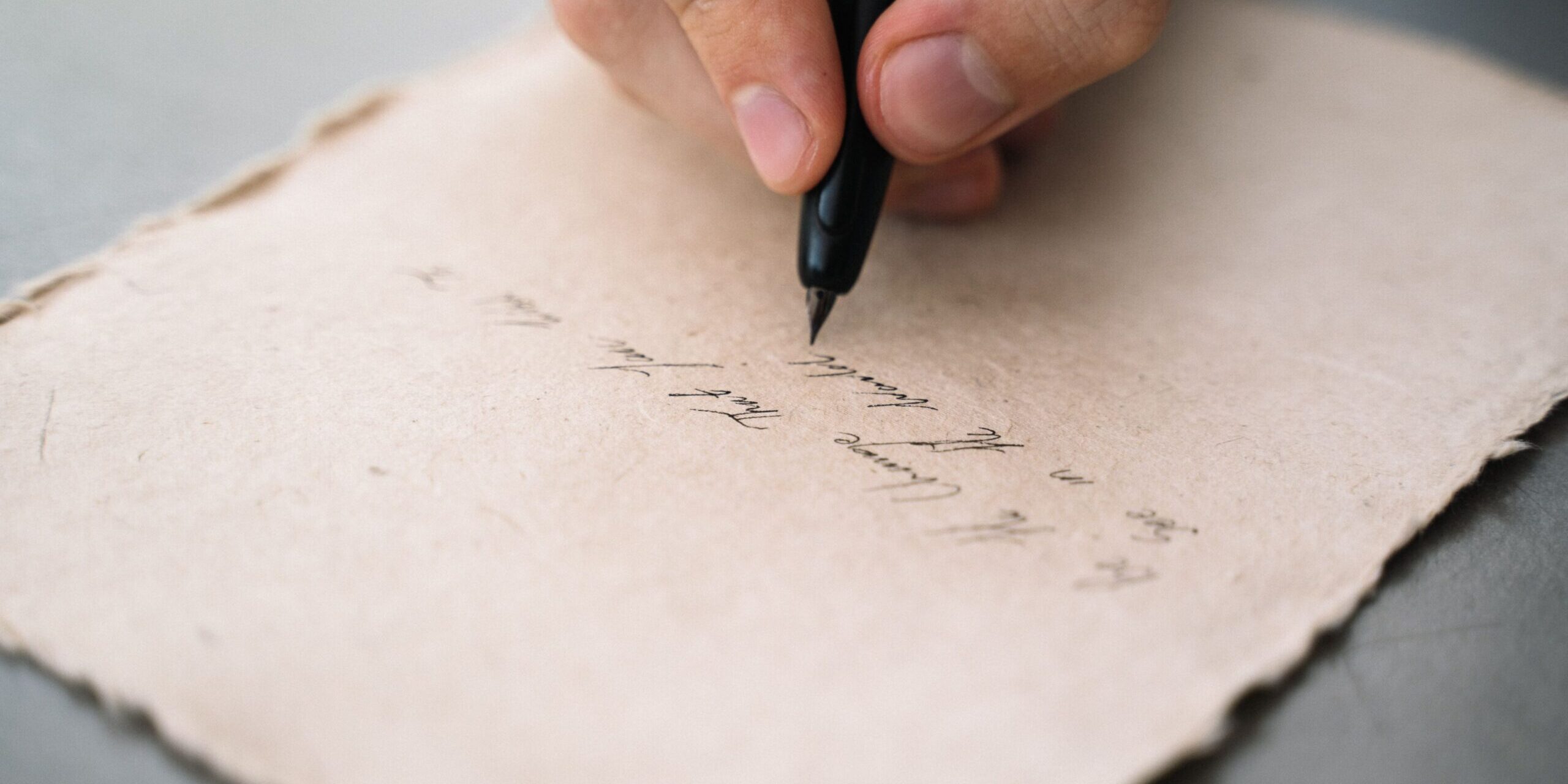
Do you remember your first attempts at writing by hand?
Through the mists of time, I recall that I read before starting school but writing of any coherent sort came a little later.
In the first years of school, we began an apprenticeship which began with chalk and blackboards, to the chunky pencils with those satisfyingly thick carbon strokes and then the challenge of fountain pens and rogue ink.
Each time our little hands strove to write finer, smaller and – it was urged – more elegant letters, alchemised from uncertain marks to cursive script.
There were whole school periods given over to tracing and forming a style of “penmanship” which was considered part and parcel of the literacy skills of a child. But it was more than that – handwriting determined cultural identity and personal individuality.
People would say they could work out which era, family or school an adult’s handwriting came from.
I remember a kindly FCJ religious sister frowning with worry over my shoulder as I tackled a pen. I was that difficult thing – a left-hander! I am sure I was covered in royal blue ink. Sister tried to persuade me that life as a lefty would be blighted. As self-conscious as this made me, I was romantically determined, come cramped hands and nebulae of ink smears to make my way in the small 10 per cent of the planet who write using the right hemisphere of the brain (as apparently left-handed writers do).
It is difficult for people of my vintage and older to imagine schooling without the labours of penmanship. With the advent of digital devices, students growing up in more recent generations have had little to no training in the human technology of handwriting.
In a 2025 article entitled “Vanishing Ink”, the authors surveyed people aged between 15-25 and found that there was little familiarity with writing, signatures or handwritten exams. While digital skills were found to be very useful in many ways, the authors found that:
“The cons are significant: diminished fine motor skills, loss of personal expression, reduced memory retention linked with handwritten notes, and concerns about spelling and syntactic accuracy due to auto-correct reliance.”
Italian researchers at the Gemelli and Sacro Cuore hospitals found that automatic reliance on digital literacy in young children with no formation in handwriting not only created a lopsided set of skills – it also affected aspects of children’s mental and emotional wellbeing. (Children 2026, 13(7), 940).
Digital communication did assist students with dyslexia, those on the autism spectrum and those with other physical challenges to complete certain tasks, however over-dependence upon digital screens for communication and the absence of handwriting could “contribute to attentional fragmentation, sleep disruption, social comparison, emotional dependence on online feedback, and problematic or addictive patterns of use in vulnerable children and adolescents”.
Over the last years, neurophysiological researchers Professors Audrey van der Meer and Ruud van der Weel at the University of Technology of Norway have been deploying innovative 256-channel high-density EEG arrays to measure and document human brain activity in university students while comparing handwriting and typing.
Handwriting was found to activate many more parietal and central brain regions than typing on a device. Once again, handwriting lit up brain patterns crucial for encoding new information and for preserving memory in these older students.
The team’s 2024 study published in the journal Frontiers in Psychology noted:
“When writing by hand, brain connectivity patterns were far more elaborate than when typewriting on a keyboard, as shown by widespread theta/alpha connectivity coherence patterns between network hubs and nodes in parietal and central brain regions.”
In a press release, Professor van der Meer wrote, “We have shown that the differences in brain activity are related to the careful forming of the letters when writing by hand while making more use of the senses.”
Their recommendations to educators in Norway and in other parts of Europe have urged the systematic revival of handwriting education early in a child’s education and throughout their education.
Many in the liberal, scripture-based and classical arts educational world are also reviving handwriting in education because it is an incarnated, civilisational and virtue-based practice. Handwriting, these teachers argue, encourages an inner-life, personal autonomy and patience.
St Paul made a point of authenticating his usually dictated thoughts by signing off with chirographic comments in his letters to the Galatians, Philemon and Colossians and elsewhere. He writes in Galatians 6:11, “See with what large letters I am writing to you with my own hand.”
Educational writers have found that handwriting slows the thought process with good results, making writing more mindful, engaged and personal. There is much evidence it enables students to both listen and remember while writing. It is clearly a demonstration of a personalised and almost sacramental expression of the person. It is a pedagogical “theology of the body” enacted in cognitive development and the fine-motor expression of the hand.
In paragraph 114 in his first encyclical Magnifica Humanitas, Pope Leo XIV considers the AI revolution in the light of Catholic Social Teaching. He argues that certain counter-cultural and humane practices must be preserved in the midst of the digital revolution. He cites as examples:
“Reading stories to a child, offering company to an elderly person and arranging a home so that it is welcoming are simple gestures often rooted in family life.”
What Leo calls an “ecology of communication” is not always at war with technology, and sets up a humane practice which involves embodiment, personalised expression and judgement so that personal attention, authentic care and true moral freedom is preserved.
The pen may well be mightier than ever in the development of Christian humanism in the midst of AI.
Anna Krohn
Executive Director
Thomas More Centre