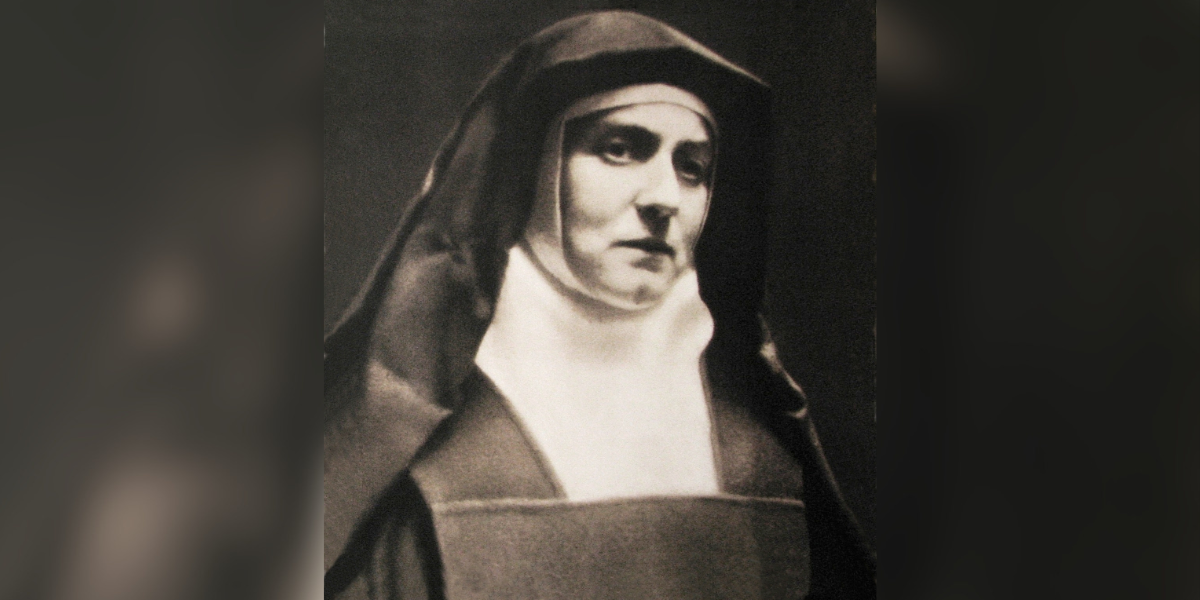
As the month of August comes around each year, I find myself returning to the witness, holiness and wisdom of Edith Stein, St Teresa Benedicta of the Cross OCD (1981-1942).
Her rigorous mind and her keen social and psychological ethos are critically needed in our own times of unhinged emotive reaction, as much as in the face of the AI onslaught.
As well as her important writings and talks on women, intersubjectivity and education are the prophetic elements of her deeply integrated and expressive life. Wonderful insights of this are available in the first Edith Stein biography, written by her Prioress in the Cologne Carmel, Teresia Renata Posselt OCD, and philosophical study of her intellectual and religious conversion by the great Scottish-American philosopher Alasdair MacIntyre.
Sister Teresa and her sister Rosa were herded into the murderous mechanics of the Auschwitz gas chambers on August 9, 1942.
The ruthless “logic” of the gas chambers was diametrically and fatally hostile to all that St Teresa was: a contemplative Catholic religious, a woman of Jewish heritage and as a deeply personalist philosopher and ethicist. She and Rosa died invisibly amidst the mass murder of “her people”, as she called them.
It is estimated that the cattle rail-trucks off-loaded 510 male and 477 female targets for forced labour and extermination on the single day of August 8, 1942, just one day’s quota of the estimated million who were killed in that one place.
At the homily canonisation in 1998, Pope St John Paul II titled her a patron of Europe and “this eminent daughter of Israel and faithful daughter of the Church as a saint to the whole world”.
In August, ten years later, Pope Benedict XVI would twin St Teresa with the Franciscan, St Maximilian Kolbe, as lights in the dreadful primal dark of Nazi violence. He writes of the survivors who observed: “Teresa Benedicta of the Cross, dressed in the Carmelite habit … making her way, consciously, toward death, she distinguished herself by her conduct full of peace, her serene attitude and her calm behaviour, attentive to the needs of all.”
St Teresa is important because she not only studied empathy with careful attention – she drank it to the dregs in the fiery furnace.
It has become somewhat clichéd that certain (largely American) “conservative” commentators have bagged “empathy” as a sign of modern collective failure. Hillary Clinton calls this in retaliation “the war on empathy”.
The war on the word “empathy” probably took its present form about five years ago with the global billionaire Elon Musk’s throwaway line that “too much” empathy is a flaw of “Western civilisation”. It has been followed by a spate of books and articles which identify a “toxic” or excessive mass-empathy evident in “liberal” cultures.
One prominent voice in this is the Lebanese-Canadian evolutionary psychologist Gad Saad with his best-selling book, Suicidal Empathy: Dying to Be Kind.
More provocative still is the work of writers such as the evangelical Christian, Joe Rigney, who argues that empathy is a banner term for “the greatest rhetorical tool of manipulation in the 21st century” and he extends this argument in his book, The Sin of Empathy. He goes further by claiming that “women’s empathy” is just the entry point for the “sin” which corrupts Church leadership and doctrine today.
It is valuable to realise that it was precisely Edith Stein, woman and saint over a hundred years ago, who dedicated her doctoral work to a meticulous phenomenological doctoral study defining empathy not as an emotional pathology, but as an act and a commitment.
In 1917, Edith published her doctoral thesis while working as a research assistant for the leading German phenomenologist philosopher, Edmund Husserl. Her thesis was titled, “On the Problem of Empathy”.
In this work, written while Edith was still loosely agnostic (she would be baptised in 1922) and after she had worked nursing the wounded in the devastating Great War, her analysis tackles dualistic, idealistic and deterministic readings of “empathy”.
As MacIntyre will note in his study, it is evident that Edith is already at this point moving towards a Thomistic-Catholic anthropology of the human person. Firstly she notes that empathy is a perception unique to embodied spiritual beings. Empathy is not, she argues, the same as “fellow-feeling”, emotional contagion, sentimental projection or mimicry. We perceive the grief, joy or boredom of another person, because their inner experience is expressed through their “lived-bodily” presence (leib).
There is a second aspect to the action of empathy. According to Edith, it is a cognitive and moral one. In this we recognise that the person “is other” (or foreign) to us and yet we choose to understand that their inner experience has some import. Steinian empathy is deeply intentional and objective.
MacIntyre argues that this offers a balanced and original understanding of empathy which preserves the uniqueness of each person, and yet enables a clear setting for genuine intersubjectivity. It is an embodied response which involves the intellect and the moral sense – a perceptive act formed by a life of virtue.
Not only is this type of empathy an answer to “wokeish” emotivism; it is a corrective to an outraged and hard-hearted conservatism. Furthermore, this type of empathy resists the homogenising of the often “people-pleasing” AI algorithms. Machine learning does not have an “inner life” or an embodied presence. As writer D.R. Esparza, writing in 2025, observed of Stein’s empathy:
“It is a first-person experience of someone else’s inner life. Crucially, empathy does not blur the lines between self and other. It allows us to remain ourselves, while genuinely entering, with care and restraint, into the lived experience of another. This balance – of nearness without appropriation – makes empathy not just an emotional act but an ethical one.”
He continues: “Today’s AI systems can produce what appear to be empathic responses. Chatbots can offer words of comfort, algorithms can detect sadness in a voice or hesitation in a text. These responses may sound convincingly human. But what they lack, Stein would insist, is presence.”
At the Thomas More Centre, we want to identify the real needs of people in our regions with clear-headed sense, and to live up to the heroic “empathetic” intentionality which St Teresa lived and died.
Anna Krohn
Executive Director
Thomas More Centre