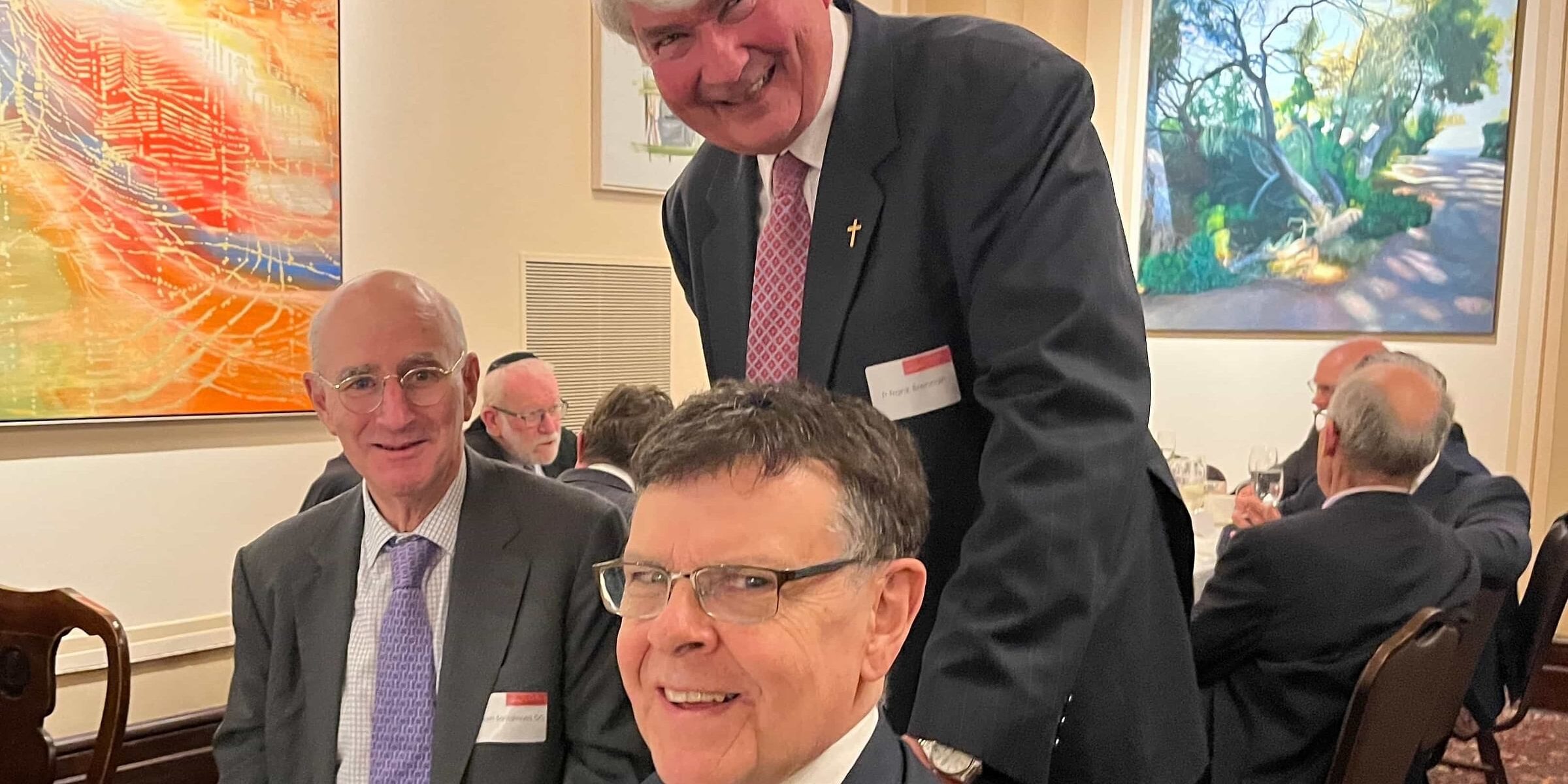
Above image: The Hon Joseph Santamaria KC, Fr Frank Brennan SJ and the Hon Justice Tim Ginnane (front) at an event hosted by the Melbourne Catholic Lawyers’ Association (MCLA). (Photo courtesy of MCLA.)
Last week in the TMC newsletter, we published a short tribute to our eminent patron, the Hon. Joseph Gerard Santamaria, who died at the age of 78 on July 23.
The full St Patrick’s Cathedral for his Requiem Mass on July 31, appropriately on the feast of St Ignatius of Loyola, was entirely fitting and inspiring.
Joseph was that rare man in Australia – a humble, deeply prayerful, astute and mostly hidden philanthropist. His generosity was self-effacing and completely counter-cultural to the attention-seeking of our times. His support often came with timely personal advice that was short and crisp in words yet significant in practical terms.
Joseph’s example is enduringly instructive to the mission of the Thomas More Centre.
Along with being B.A. Santamaria’s eldest son, Joseph began his secondary studies – as did his younger brothers – at an exceptional boys’ school (now demolished save one remaining tower), St Patrick’s College, which was located next to the Cathedral of the same dedication in East Melbourne.
The College developed a distinctive ethos.
It is no coincidence that the intellectual calibre, social awareness and commitment of my father, Francis Xavier (1927-1999) and his brother, Fr Paul Duffy SJ (1931-2013) were seeded in that same College. It also formed later generations of men, including my husband Anthony, in a similar vein for a few years before its regrettable closure in 1968.
St Patrick’s was founded under Archbishop Goold in 1854 as part of the Melbourne Diocese. Its classical bluestone towers and construction were both compact and formidable given its site nestled beside the monumental Cathedral.
The Jesuits were given charge of the College in 1865. Unlike other Australian Jesuit colleges, St Patrick’s did not have expansive grounds, but thanks to a scholarship system catered to Catholic families of varying economic means. Its relatively smaller community developed a reputation for great camaraderie, consistently high academic standards and for a character formation which encouraged many of its graduates to be deeply engaged in the life of the Church and civic duty.
When asked about building a minor seminary, Archbishop Daniel Mannix is reported to have said that he had no need for a minor seminary while he had St Patrick’s. The school shared the Archbishop’s private chapel.
The Old Patricians, the alumni association, is preserving the pictorial history of the College in a fascinating collection.
Joseph Santamaria began at St Patrick’s in Grade 5 and made his mark in the well-rounded curriculum of the College. He excelled in history, mathematics and languages as well as in College athletics and football. He was notable in the College debating club, and the alumni journal The Patrician (July 2026) notes of “Joe Santa” (as he was known at school):
“Naturally, he was a committee member of the Debating Team and made valuable contributions to their competitions, giving advance notice of the quality of his legal arguments after completing his tertiary studies in Melbourne and abroad.”
Joseph matriculated at St Patrick’s as school captain and dux of 1966, and commenced studies at Melbourne University the following year in Law and Arts with his particular interest in philosophy. In a note to the alumni newsletter, Joseph describes his final years at the College and at university as being a time in which he was acutely aware of moral and theological debates in the immediate years after the Second Vatican Council.
At university Joseph encountered the writing and thought of John Finnis (1940-), the outstanding Adelaide-born scholar of jurisprudence and natural law philosophy. Joseph writes of Finnis: “He left a major and lasting influence on what I have done and what I have thought about since then.”
John Finnis in the 1970s began his collaboration with the American moral theologian Germain Grisez (1929-2018) initiating a moral and legal movement known as “New Natural Law” (NNL). This would directly contribute to a wave of other Catholic “natural law” students and notable scholars including: Robert P. George, Joseph Boyle, Gerard Bradley, Fr Kevin Flannery SJ, Archbishop Anthony Fisher OP and many others.
The NNL movement sought to counter reductive positivism in legal theory and consequentialism in moral philosophy and bioethics, with an approach to ethics and legal discussion which considered certain fundamental “human goods” integrative, non-reducible and evident to human practical reason. The movement also sought to bring its reasonable “human goods” approach into debate and dialogue with pressing issues in wider ethical and legal debates.
A helpful recent account of this movement and some of the friendly critical interlocuters from the Thomist and “Communio” movements to NNL can be found in the American Journal of Jurisprudence by the Hungarian scholar, Ferenc Hörcher.
Not only did Joseph continue to find Finnis’ work compelling, but after completing a thesis on the topic of “The Right to Work” at Melbourne, he took up a scholarship to study under Finnis at Oxford University. He graduated from Oxford with a Bachelor of Civil Law and a Bachelor of Letters.
Joseph and his Oxford wife Soonie returned to Australia with a growing family. He became senior tutor at the Melbourne Law School. He writes that he loved teaching but needed to augment his income by becoming a barrister in order to support his five children.
While at the Bar, Joseph specialised in equity and company law, making a major contribution to the field with Ian Renard in their foundational textbook, Takeovers and Reconstructions in Australia.
In 2013 Joseph was elevated to the Bench of the Court of Appeal of the Supreme Court of Victoria.
While in his “day job”, Joseph applied his considerable mind to “equity” issues, and his dedication to promoting the intersection between the secular rule of law with Catholic Social Teaching continued in his study and friendships. He contributed through his quiet mentoring, teaching and legal work what his father had given to the political and cultural world.
Many will remember Joseph Santamaria’s advice and research in the realms of healthcare law and on topical moral issues. His gift for friendship established loyal and regular guests to his home including the star scholars and friends from his Oxford days. They will remember his dry humour which could catch them off guard.
In the early years of the Thomas More Centre Summer Schools, Joseph was often the agent with his uncle Dr Joe in enabling the stars such as John Finnis, Germain Grisez, Fr Paul Mankowski SJ and others to feature in TMC talks and other Australian events.
Joseph and Soonie were marvellous hosts and many high-profile speakers, thinkers and Church dignitaries were able to find respite from the public glare in the warmth of their home and table.
Not only did Joseph Santamaria host speakers, he also supported the formation of young people at Summer Schools and YPAT events by presenting his own talks and papers. He presented memorable sessions on conscience, on the rule of law and other topics.
Joseph Santamaria was an esteemed figure for so many. He was a patrician in the deepest sense of the word.
The Thomas More Centre is very grieved by the loss of such a pillar to our work and we pass on our deepest condolences to Soonie, Fr Jerome and all the Santamaria siblings and wider family. We pray for his repose and that we can honour his legacy in our endeavours.
A fine tribute by the Melbourne Catholic Lawyers Association can be found here, and the recording of the Requiem Mass for the Repose of the Soul of Joseph Santamaria at St Patrick’s Cathedral, Melbourne on July 31 can be viewed here.
Anna Krohn
Executive Director
Thomas More Centre